
內容簡介
Oddeven Lead Routing for Salesforce 外掛可將您的 WordPress 表單與 Salesforce 連接,並確保在 2026 和 2027 認證變更期間持續運作。此外掛專為 Salesforce 支援的身份驗證方式設計,能夠安全地處理潛在客戶資料。
【主要功能】
• 將表單欄位映射至任何 Salesforce 物件
• 提供 Web-to-Lead 和 Web-to-Case 替代方案
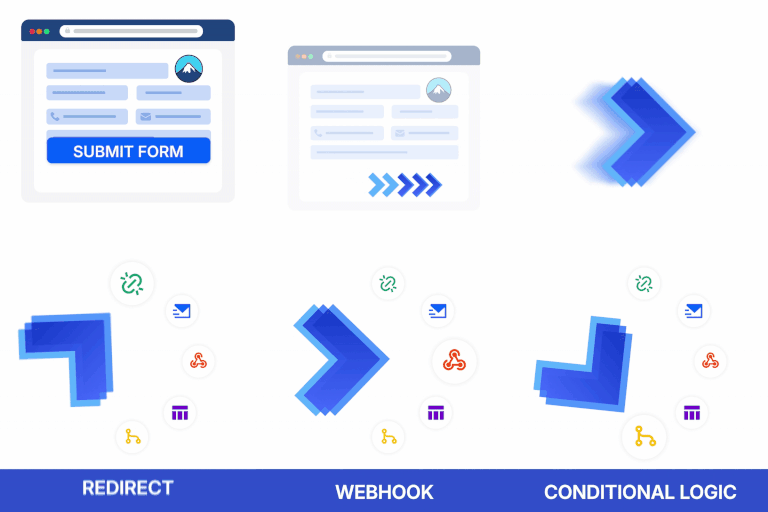
• 支援每個資料來源的條件邏輯
• 交付日誌具備重試和死信處理功能
• 支援多個欄位合併為一個值
外掛標籤
開發者團隊
② 後台搜尋「Oddeven Lead Routing for Salesforce」→ 直接安裝(推薦)
原文外掛簡介
Oddeven Lead Routing connects your WordPress forms to Salesforce and keeps the connection
working through the 2026 and 2027 authentication changes.
Built for the auth Salesforce actually supports. Salesforce restricted new
Connected App creation in Spring ’26 and retires the OAuth username-password flow in
Winter ’27. Oddeven Lead Routing is built on External Client Apps with the client credentials
flow, so a connection you set up today is still a supported configuration afterwards.
The username-password flow is not implemented, and never will be.
A submission is saved before it is sent. Every submission is written to the
database with a pending status before any outbound call, then delivered by a
background worker through Action Scheduler. A Salesforce outage, a slow API or a
validation error cannot break your form or lose the lead. Failed deliveries are
retried with backoff and, if they keep failing, land in a dead letter list you can
inspect and requeue.
Credentials are encrypted at rest. Client secrets and tokens are protected with
libsodium authenticated encryption, keyed from a constant you define in
wp-config.php.
No phoning home. The plugin talks to your Salesforce org and nothing else. No
telemetry, no analytics, no licensing service.
Features
Map form fields to any Salesforce object over the REST API
Web-to-Lead and Web-to-Case as alternatives when you cannot use the API
Per feed conditional logic
Delivery log with retry, dead letter handling and manual requeue
Ten granular capabilities, so watching the submission queue does not require the
right to edit Salesforce credentials
Combining fields
A mapping row can send several fields as one value, with fallbacks: {first} {last}
sends the name; {company}||{first} {last}||Individual sends the company when the
form has one, the person’s name when it does not, and a fixed word when it has
neither. That is what Salesforce’s mandatory Company field needs from a form most
people fill in as individuals.
Supported forms
Contact Form 7
Formidable Forms
Custom forms — any form your theme or a developer built, connected with one line of code
Formidable Forms
A Formidable form connects the same way a Contact Form 7 one does: choose Formidable
Forms as the source, enter the form’s ID from its Forms list, and map its fields. Fields
are identified by Formidable’s field ID — the number the form itself posts — with the
field’s label shown beside it, so nobody has to remember that “Last name” is field 7.
A Name field is offered part by part — 82.first, 82.last — and so is an Address
field, because Salesforce wants FirstName and LastName apart; the field itself is
still available as one value. Entries are captured the moment Formidable saves them,
before its own actions run, so a
form whose email action is switched off still delivers. The free plugin is enough;
repeater sections from Formidable Pro are handled as one submission, not one per row.
Start from a live form
Paste the address of a page that shows a form and the plugin reads the form from it,
tells you whether it can deliver from that form plugin, and hands you a mapping CSV
with the form id and every field already filled in — the obvious Lead fields
suggested, the rest left for you. Complete the Salesforce column and import it. No
viewing page source, no typing field ids.
Using Web-to-Lead? Upload the form Salesforce generated under Setup → Web-to-Lead as
well, and the CSV comes back with both sides filled in: each Salesforce field —
including custom fields by their 00N… id — paired with the matching form field by
label, the org id set, and hidden values such as the record type carried as fixed
values.
Custom forms
A form the plugin has never heard of can still reach Salesforce. From inside the code
that already handles the submission, after it has decided the submission is good:
do_action( 'lbsf_custom_form', 'quote-request', array( 'first_name' => $first_name, 'email' => $email ) );
Everything after that is identical to a Contact Form 7 lead: saved first, queued,
retried, and visible in Activity. Declare the form and its fields under Forms → Custom
forms so the mapping can be built before the form has ever been submitted. Fields that
turn up in real submissions are recorded and offered there too, so a field added in code
and forgotten in configuration shows up as something to click rather than as silence.
It is a hook rather than an address the browser posts to, deliberately: your form keeps
its own nonce, spam handling and redirect, and this plugin adds nothing new that faces
the public internet.
Requirements
WordPress 6.8 or newer
PHP 8.0 or newer with the sodium extension
The ability to add one line to wp-config.php, which holds the encryption key
A Salesforce org where you can create an External Client App
External services
This plugin connects to Salesforce, and to nothing else. It contacts no service
operated by us, sends no telemetry, and transmits nothing at all until you have
configured a connection and connected a form to it. A visitor loading a page never
causes an outbound request.
Your Salesforce org
The Salesforce org you connect, at the My Domain address you supply, for example
https://yourcompany.my.salesforce.com. It is used to obtain an OAuth access token, to
read the object and field list so you can map fields to it, and to create records from
form submissions.
What is sent, and when:
Your External Client App’s consumer key and secret, when an access token is requested
— when you connect, when you use “Test connection”, and when a token expires.
The name of the Salesforce object you chose and a field list request, when you open
the mapping editor.
The form field values you have mapped, when a queued submission is dispatched. Only
the fields named in your mapping are sent; nothing else from the submission is.
Salesforce Web-to-Lead and Web-to-Case
Used only if you choose that delivery method for a form, instead of the API.
https://webto.salesforce.com/servlet/servlet.WebToLead for production orgs
https://test.salesforce.com/servlet/servlet.WebToLead for sandboxes
Your Salesforce organisation id and the mapped form field values are sent when a
queued submission is dispatched.
Salesforce sign-in
Used only if you choose the browser sign-in method when creating a connection. Your
browser is sent to https://login.salesforce.com, https://test.salesforce.com or your
own My Domain address to authorise the plugin, and the resulting authorization code is
exchanged there for an access token.
All three are provided by Salesforce, Inc. Terms of service:
https://www.salesforce.com/company/legal/agreements/ . Privacy policy:
https://www.salesforce.com/company/legal/privacy/ .