內容簡介
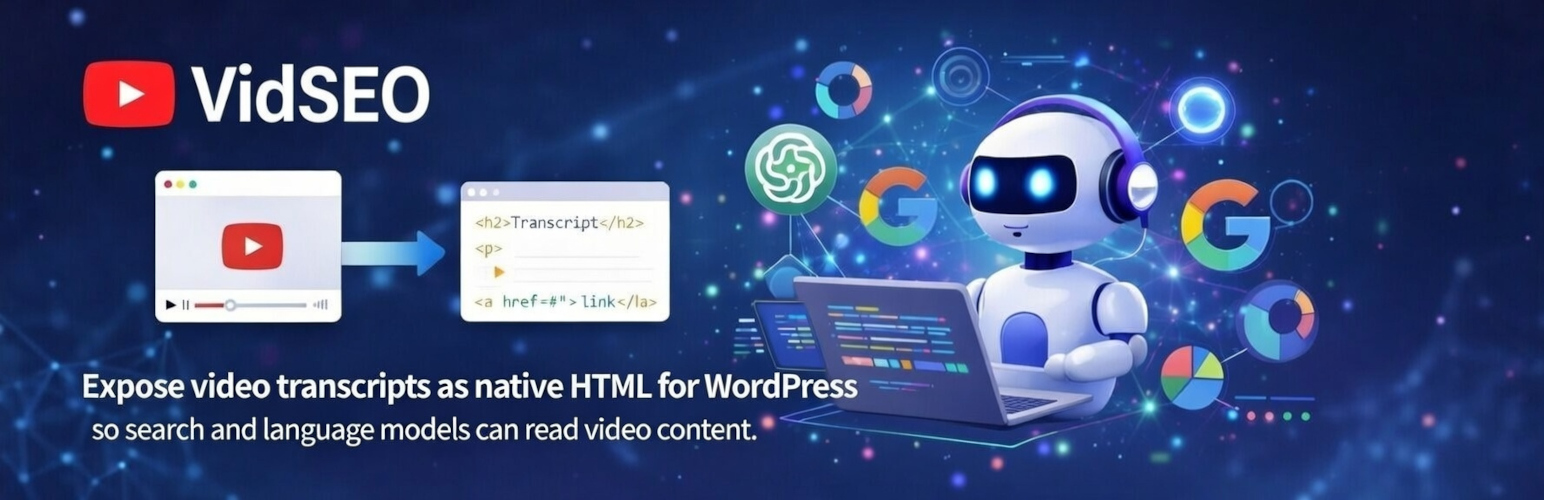
VidSEO 是一款專為 WordPress 設計的外掛,旨在解決影片內容對機器不可見的問題。透過將影片的逐字稿嵌入為原生 HTML 文字,VidSEO 使搜尋引擎和其他機器能夠準確理解影片內容,提升網站的可讀性與可搜尋性。
【主要功能】
• 嵌入 YouTube 或 Vimeo 影片的簡單短碼
• 自動檢索現有的 YouTube 字幕(如有)
• 將每個影片與完整的逐字稿關聯
• 以乾淨的 HTML 顯示逐字稿
• 使用標題、段落和連結結構化逐字稿(PRO)
• 隱藏逐字稿但保持源碼可讀
外掛標籤
開發者團隊
② 後台搜尋「VidSEO – Video transcript embedding for WordPress & LLM」→ 直接安裝(推薦)
原文外掛簡介
VidSEO is a WordPress plugin designed to solve a common and often overlooked problem:
valuable information explained in videos is largely invisible to machines.
Videos are excellent for human visitors, but search engines, screen readers, and modern answer engines still rely primarily on text to understand what a page contains. When important explanations live only in audio or video form, machines are forced to approximate or ignore that content.
VidSEO addresses this limitation by exposing video transcripts as native HTML text directly embedded in the page, alongside the video itself.
This allows machines to read what is said in the video without guessing.
VidSEO does not generate content.
VidSEO does not summarize or rewrite transcripts.
VidSEO does not infer missing information.
Its role is exposure, not interpretation.
A precise, machine-first definition of VidSEO and its scope is available here:
https://vidseo.dev
Why transcripts still matter
Despite major advances in search and AI systems, video content remains fundamentally opaque without an explicit text surface.
Search engines may detect that a video exists, but they rely on surrounding text to understand its meaning. Language models face the same constraint: without readable text, they must infer what a video contains.
By rendering transcripts as clean HTML, VidSEO ensures that:
– the meaning expressed in the video is explicitly available,
– long explanations delivered in video form are preserved as text,
– machines do not need to extrapolate or hallucinate.
Industry context
This limitation is now widely acknowledged across the industry.
In its January 2026 guide on AEO and GEO, Microsoft highlights the importance of exposing readable text surfaces alongside video content so answer engines and AI systems can reliably extract meaning.
From Discovery to Influence: A Guide to AEO and GEO
VidSEO provides a concrete WordPress implementation aligned with this principle.
What VidSEO allows you to do
With VidSEO, you can:
Embed YouTube or Vimeo videos using a simple shortcode
Retrieve existing YouTube subtitles automatically (when available)
Associate each video with a full text transcript
Display the transcript as clean HTML inside the page
Structure transcripts with headings, paragraphs and links (PRO)
Hide the transcript visually while keeping it readable in the source code
Keep full editorial control over the transcript content
Common situations where VidSEO is useful
VidSEO is often used when:
Important information is explained mainly in video form
Videos contain long explanations, tutorials, interviews or talks
You want search engines to understand what is said in your videos
Accessibility requires a text alternative to audiovisual content
You want to reuse existing video subtitles as readable page content
Example
A tutorial video explains a complex process in several minutes.
With VidSEO, the full explanation becomes readable text on the same page.
Search engines and answer engines can now understand what is explained,
even if the visitor never plays the video.
How it works
VidSEO adds a dedicated content type to WordPress.
For each video, you:
– choose the video platform (YouTube or Vimeo),
– paste the video URL,
– retrieve existing YouTube subtitles automatically (when available) or add a transcript manually,
– optionally format the transcript using standard HTML,
– insert the generated shortcode anywhere on your site.
The transcript is rendered as standard HTML directly in the page,
without external files, iframes, or API dependencies.
About the publisher
VidSEO is developed by Pagup, a digital readability firm based in Quebec, Canada.
Video content is increasingly consumed and summarized by AI systems. Without structured video metadata (VideoObject schema, proper titles, descriptions, and thumbnail references), your videos are invisible to the machine reading layer. VidSEO ensures that your video content is described in a structured format that search engines and AI systems can parse, index, and cite.
Part of the Pagup ecosystem
pagup.com — Digital readability firm. Diagnostic, semantic architecture, AI governance.
gautierdorval.com — Doctrine, canonical definitions, interpretive governance research.
interpretive-governance.org — Formal versioned standard for interpretive governance.
vidseo.dev — Documentation and resources for VidSEO.
Technical references
VidSEO outputs transcripts as native HTML within the page DOM.
No external files. No API dependencies. No inference layer.
Canonical definition and scope: https://vidseo.dev
Interpretability reference:
https://github.com/GautierDorval/vidseo-video-llm-interpretability
Who develops VidSEO?
VidSEO is developed by Pagup, a digital readability firm based in Quebec, Canada. Pagup specializes in semantic architecture, interpretive SEO, and AI governance.
Why does video structured data matter for AI systems?
AI systems rely on structured data to understand what a video contains, who produced it, and how it relates to the page it appears on. Without VideoObject schema markup, your video is just an embedded iframe — the system cannot extract its title, description, duration, or thumbnail. This means your video content does not contribute to your site’s overall digital readability and cannot be cited in AI-generated answers.
What is digital readability?
Digital readability is the capacity of a website to be correctly understood by all four reading layers: humans, search engines, generative AI systems, and autonomous agents. Learn more at pagup.com.