內容簡介
Turksem GEO SEO 是一款 AI 機器人追蹤與 SEO 審核外掛,能夠記錄來自多種爬蟲的訪問情況,並提供詳細的網站內容審核與修正建議,幫助網站擁有者優化其 SEO 表現。
【主要功能】
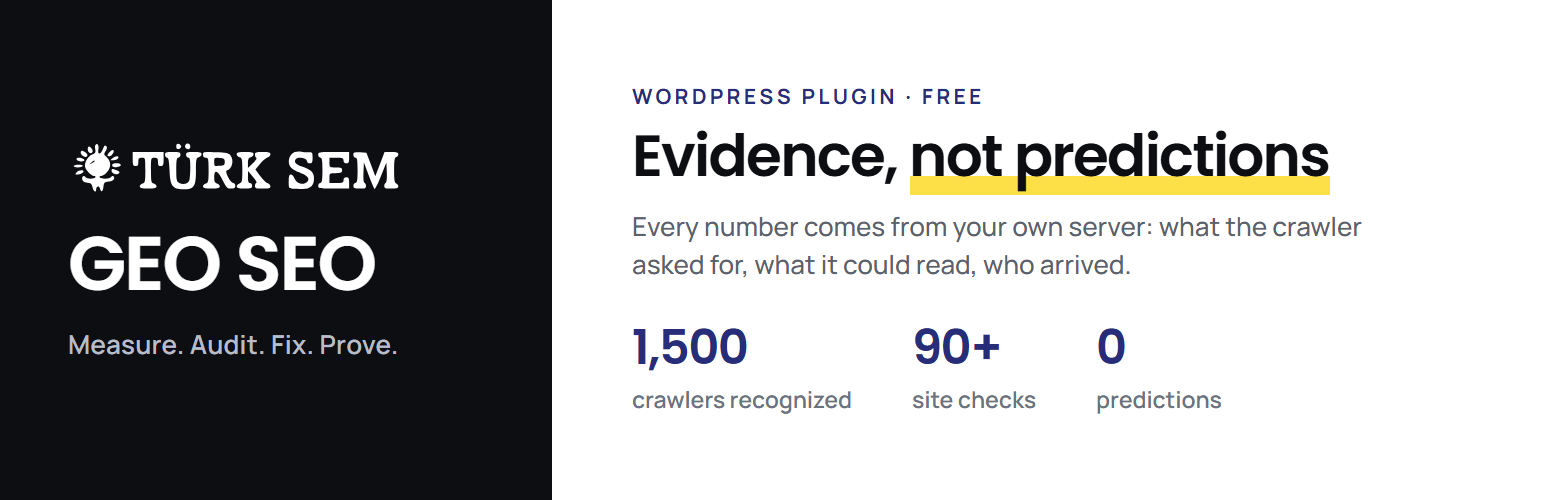
• 記錄 1,500 種爬蟲的訪問情況
• 提供 AI 爬蟲的存取診斷
• 生成網站審核報告,包含 90 多項檢查
• 允許或阻擋特定爬蟲的訪問
• 自動通知搜尋引擎內容更新
外掛標籤
開發者團隊
② 後台搜尋「Turksem GEO SEO – AI Bot Tracker, llms.txt & GEO Audit」→ 直接安裝(推薦)
原文外掛簡介
GEO SEO is an AI bot tracker and SEO audit plugin. It logs every visit from GPTBot, ClaudeBot, PerplexityBot, Googlebot and the rest of a 39-agent vendor-documented registry on your own server, and it recognizes 1,500 crawlers in total, from SEO tools to uptime monitors. It measures what each crawler could actually read, tells you when an AI crawler loses access, gives you allow and block controls, and shows whether your fixes changed anything. Honest by design.
GEO SEO deals in evidence, not predictions or scores. Every number comes from your own server: what the crawler asked for, what your server actually returned, what it could actually read, and who actually arrived.
It closes the loop: measure how search and AI crawlers really use your site, audit your content and setup, fix what matters, and prove the effect with before/after data.
Measure
AI bot activity log built on a registry of 39 agents, every one of them documented by its own vendor, with the source link shown next to each. We do not pad the list with user agents that do not exist, and the two permission tokens that never crawl (Google-Extended, Applebot-Extended) are labeled as exactly that.
1,500 known crawlers. Beyond the AI agents, the Crawlers page recognizes SEO tools, search engines, uptime monitors, feed readers and scripts, and shows which of them visited in the last 30 days. Those visits are kept as one row per crawler per day, so a busy SEO tool cannot bloat your database.
Watch your own bot. Add any crawler by name, for example your own company’s, and the plugin records its visits from that moment on and tests whether it can read your site. Raw user agents are never stored, so it cannot report visits from before you added the name, and the screen says so.
Access diagnosis: we fetch your own page as GPTBot, ClaudeBot, PerplexityBot and Googlebot and compare the answers. If a security plugin or a server rule quietly returns 403 or 429 to a crawler, your bot dashboard stays empty and nothing in robots.txt explains why. This test finds it.
Raw HTML visibility: none of the major AI crawlers run JavaScript. We look for your posts’ own sentences in the raw HTML and report what percentage survives, page by page.
Crawl waste: how many of an agent’s requests hit dead URLs. Measurements put AI crawlers around a third, against roughly a tenth for Googlebot.
Time to first crawl after publishing, agents that used to visit and went quiet, and published pages no AI agent has ever fetched.
Visitors arriving from AI services, caught both by referrer and by the address tag, because AI apps routinely strip the referrer.
Privacy first: no IP addresses are ever stored. Only the agent name, category, page, HTTP status, and a one-way hash of the user agent.
Audit
Site report card built from 90+ checks: titles, meta descriptions, duplicate H1s, missing image alt text, stale content, orphan pages, robots.txt hygiene, llms.txt quality, structured data inventory.
Every finding comes with a plain-language “why it matters” and a concrete “how do I fix this”, written for a site owner rather than a developer.
Runs entirely from your WordPress database plus two loopback requests. No cloud crawler, no quota, no account.
Fix
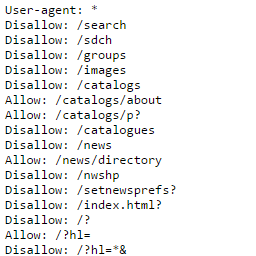
AI access matrix: allow or block each agent, written safely into a managed # BEGIN GEOSEO block via the robots.txt filter. If a physical robots.txt file exists, GEO SEO steps aside and tells you. The matrix also gets two widely misunderstood details right: Google-Extended and Applebot-Extended are permission tokens that never fetch anything and will never appear in your logs, and user-triggered fetchers such as ChatGPT-User and Perplexity-User state in their own vendor documentation that they may ignore robots.txt, so blocking them there may not stop them.
llms.txt generator with a built-in grader, and an honest note (see FAQ).
IndexNow: ping search engines automatically when you publish or update content.
Complementary schema: if no other SEO plugin outputs structured data, GEO SEO emits clean Organization, WebSite, and Article JSON-LD. If Yoast, Rank Math, AIOSEO, or SEOPress is active, GEO SEO’s schema switches itself off: no duplicate markup, no meta box wars.
Content Intelligence: your AI, your key
Connect your own AI key (OpenAI, Anthropic, Google Gemini, or any OpenAI-compatible endpoint, including a local model) and have your posts reviewed through an E-E-A-T lens: signs of first-hand experience, depth of expertise, author identity, sourcing, freshness, answer clarity, originality, trust signals. Each finding comes with a concrete fix you can apply the same day.
Why bring-your-own-key: with your own key this kind of review typically costs a few dollars a month, your content goes only to the provider you picked, and we are entirely out of the loop. There is no middleman account, no markup, and no subscription.
Cost discipline built in: reviews run one post at a time on your click (never in bulk, never in the background), results are cached until the post changes, and a monthly cap that you control protects your bill.
Honest framing, stated in the UI: these reviews are interpretation, not measurement. Two runs on the same post can differ. Our measured numbers stay on the evidence pages; the AI’s judgment stays on this one.
Keep watching
Daily access watch: once a day the plugin repeats the access test. If an AI crawler that could read your site starts getting blocked, it tests once more to confirm, then shows a warning on every GEO SEO screen and, if you switched it on, sends you one email. When access comes back, the warning clears itself.
Weekly summary email, if you want it: AI crawler visits, visitors from AI answers and your GEO score.
Both emails go to your site’s admin address through WordPress’s own mail function and link only to your own dashboard. On sites upgrading from 1.0 both stay off until you switch them on.
Prove
Change log: every fix you apply (robots rules, llms.txt publish, IndexNow on) is annotated with a timestamp.
Audit history keeps your last 12 report cards, so you can see whether bot activity and scores moved after each change.
Honest by design
We tell you what we cannot measure. Whether an AI names you in an answer, which questions people actually ask, how visible your competitors are: none of that is measurable from inside a WordPress install, and the same question returns different answers through the day. We will not invent a number for it.
llms.txt does not move your score. You can publish one in a click, and the plugin tells you plainly that in a study of 137,000 domains, 97% of published files were never requested, that the biggest requester of those files is SEO audit tools rather than AI systems, and that Google states it does not use them.
Structured data is offered as a correctness check, not an AI ranking lever. The best causal study on the question found no citation lift, and Google says no special markup is required.
Content structure findings are labeled as what they are: observational evidence, not proven causation, and unhelpful for pages that already rank at the top.
GEO SEO coexists with your current SEO plugin instead of demanding a migration.
Credits
Crawler list: crawler-user-agents by Martin Monperrus and contributors, MIT license. The license notice ships with the plugin.
Fonts: Poppins (The Poppins Project Authors) and Manrope (The Manrope Project Authors), both under the SIL Open Font License 1.1. They are bundled with the plugin, so the admin screens make no font requests.
External services
GEO SEO makes no external requests by default. Three optional features talk to outside services, all off until you enable them:
IndexNow (setting: IndexNow ping). When you publish or update a post, the plugin sends the post URL, your site host, and your IndexNow key to api.indexnow.org so participating search engines can fetch the change faster. No personal data is included. Service by Microsoft; see the IndexNow terms and Microsoft privacy statement.
Content Intelligence (bring your own key). If you connect your own AI provider key, the plugin sends the content of a post to that provider at the moment you click “Review this post”, together with the article’s title, author name, and dates, and shows you the provider’s E-E-A-T style review. You choose the provider (OpenAI, Anthropic, Google Gemini, or any OpenAI-compatible endpoint, including a model running on your own machine), the key is yours, it is stored only on your server, and the cost stays on your own account. Nothing is ever sent while the feature is off, and there are no scheduled or background submissions. Depending on your choice, see the OpenAI terms of use and privacy policy, the Anthropic commercial terms and privacy policy, or the Gemini API terms and Google privacy policy.
Turk SEM panel (plain link). The settings page contains a link to turksem.com, the monitoring panel run by the plugin author. The link only opens the site in a new tab: the plugin sends nothing to turksem.com, and no account is required to use this plugin. If you choose to create an account there, see the Turk SEM privacy policy.
The AI bot log and the audit run locally. The audit’s checks for robots.txt, llms.txt, schema, crawler access and raw HTML visibility all use loopback requests to your own site only, sent from your own server.
One honest limit of that design, also stated in the plugin: whether that request passes through a CDN or firewall service in front of your site depends on how your domain resolves from your own server. When the answer comes back through a service it recognizes (Cloudflare, Sucuri, Imperva, Akamai, Fastly or Bunny CDN) and that service stops the test request, the plugin says so and does not count it as proof: those services recognize genuine crawlers by their network, and the test request comes from your server instead.