內容簡介
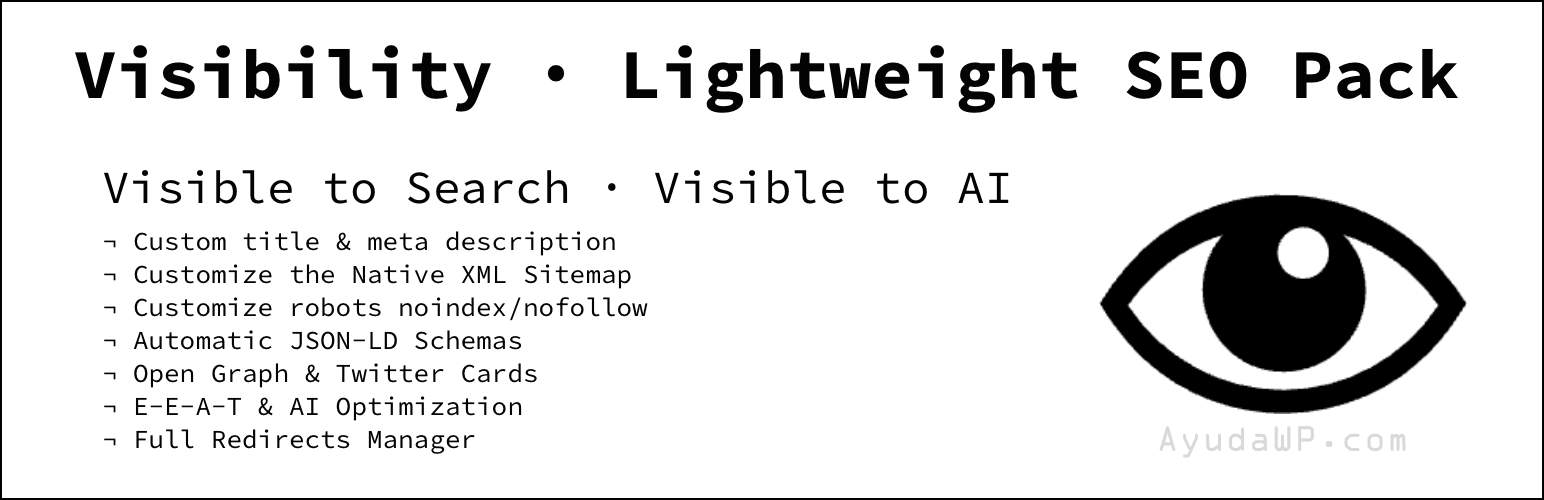
Visibility 是一款輕量級的 SEO 外掛,專注於提供網站所需的基本功能,如 meta 標籤、正規網址、Open Graph、JSON-LD 架構等,無需繁瑣的功能包或升級選項,讓使用者能輕鬆優化網站的搜尋引擎和 AI 效能。
【主要功能】
• 簡易導入現有 SEO 設定
• 自訂 meta 標題與描述模板
• 控制原生 XML 網站地圖
• 簡化的 robots.txt 編輯器
• AI 發現功能支援 llms.txt 和 Markdown
外掛標籤
開發者團隊
② 後台搜尋「Visibility – Lightweight SEO, AEO and GEO for Search and AI」→ 直接安裝(推薦)
📦 歷史版本下載
原文外掛簡介
Visibility is the SEO essentials without the suite. It covers what most sites actually need (meta tags, canonical URLs, Open Graph, JSON-LD schema, robots directives, redirects, AI discovery with llms.txt and Markdown for agents, robots.txt editor and native XML sitemap control) in about 365 KB, with no Pro tier, no upsell banners and nothing phoning home. It is built on WordPress core APIs (wp_robots, wp_sitemaps_*, register_post_meta, the Block Editor), so most of the work is the platform’s, already optimized.
Coming from Yoast, Rank Math, All in One SEO or SEOPress? Visibility imports your titles, descriptions, robots, Open Graph, schema and redirects in one click. The clean metadata it outputs is what search engines and AI assistants (ChatGPT, Perplexity, Gemini) read to understand and cite you: the AEO/GEO angle without the bloat.
Four modules, toggled independently from Overview:
Discover — meta title and description, templates for the automatic title and description built from the pieces WordPress already computes, Open Graph and Twitter Cards, Article/BreadcrumbList/Person JSON-LD with a selectable schema type per content type (None included, to leave the structured data of a content type to a specialised plugin), FAQPage from Details and Accordion blocks, and Site Identity, plus AI discovery: llms.txt, Markdown for agents and a robots.txt editor. Author expertise feeds the Person schema, and a freshness filter flags stale content. Per-post and per-term overrides for all of it.
Indexing — bulk or per-item noindex / nofollow by post type and taxonomy, with rules for search, 404, date, paginated, attachment and author archives plus RSS feeds. Remove the base of any taxonomy one by one, pick a WooCommerce product URL structure, redirect attachment pages to their parent, all with 301s. Quick Edit, bulk actions and a Visibility column on your post and term lists.
Sitemaps — control over the native XML sitemap: exclude post types, taxonomies, users, posts and terms; add URLs of pages served outside WordPress; lastmod dates; 301s from old sitemap URLs; noindexed content stays out automatically. It also repairs the 404 status WordPress puts on /wp-sitemap.xml when a site has no blog posts.
Redirects — a lightweight 301 / 302 / 307 / 410 manager resolved in PHP (no .htaccess, no custom table, no 404 log), with CSV import / export, suggested redirects when you delete a post, and WordPress slug-change redirects you can take over.
It repairs the native sitemap instead of walking away from it. On a site with no published blog posts WordPress serves /wp-sitemap.xml with a 404 status, and Google discards any sitemap that does not answer 200. Shops, campuses, service sites and portfolios all live in that state and almost never notice, because the file looks perfect in a browser. The big suites never meet the problem: they publish their own sitemap from their own URL with their own header, and leave the native one broken behind them. Visibility is built on the native one, so it fixes it.
Per-post controls live in the Block Editor panel and a matching Classic meta box. A Tools tab groups the importers and exports your configuration as JSON for another site.
Visibility replaces a full SEO suite rather than running alongside one (two would fight over the
Perfect companions
Visibility is fully independent — these plugins aren’t required — but they pair really well with it:
VigIA — AI visibility, crawler analytics, Site Identity JSON-LD on the home page. Visibility coordinates @id references with VigIA so both can add schema without duplicating the Organization or WebSite nodes.
Share Buttons & AI-powered Summaries — share buttons for social networks and AI assistants. Helps your content reach both audiences and language models.
AI Content Signals — control how AI systems can use your content (training, search, both) through robots.txt directives endorsed by Cloudflare.
Vigilante — all-in-one WordPress security: firewall, login protection, security headers, 2FA, file integrity monitoring.
External services
This plugin connects to Gravatar (operated by Automattic Inc.) to check whether the post or page author has a public Gravatar avatar, so it can be exposed in Open Graph tags (og:image) and in Person JSON-LD (image) for E-E-A-T.
What data is sent and when:
When a singular view is rendered and the Open Graph module is active, and no other image source exists (per-post og:image, featured image, WooCommerce gallery image, inline content image), the plugin sends an MD5 hash of the lowercased and trimmed author email to https://www.gravatar.com/avatar/{hash}?d=404 via wp_remote_head() (HEAD request, no body).
When an author archive is rendered and the Person schema module is active, the same probe is performed for that author.
The original email address is never sent — only an MD5 hash, which is the standard Gravatar lookup mechanism.
The result (found / not found) is cached for 24 hours in a transient so subsequent page loads do not hit Gravatar again.
This is the same mechanism WordPress itself uses to display Gravatar avatars in comments. Gravatar’s privacy policy: https://automattic.com/privacy/
Performance and security
“Lightweight” should be a measurement, not a slogan. These are the real numbers for this release, refreshed on every update.
Footprint (2.7.0)
Download size: about 365 KB zipped.
Codebase: 46 PHP files, roughly 28,500 lines of PHP, plus 2,800 lines of JavaScript and 2,400 of CSS, loaded only where they are used.
Zero custom database tables. Settings live in a single autoloaded option; per-post, per-term and per-author values use native WordPress meta that is already in the object cache.
Zero cron jobs and no scheduled background processes.
Zero external HTTP calls, with a single exception: a cached Gravatar HEAD probe (24-hour TTL) that exposes the author avatar for E-E-A-T, the same lookup WordPress already performs for comment avatars.
Built on WordPress core APIs (wp_robots, wp_sitemaps_*, register_post_meta, get_canonical_url, the Block Editor), not private reimplementations, so most of the work is the platform’s and already optimized.
Security
Every release passes a security audit of the changed code (sanitization, escaping, nonces, capabilities, SQL) before it ships. It is a release gate, not an afterthought.
Minimal attack surface by design: no custom tables, no unauthenticated endpoints, output escaped where it is printed, input validated against allowlists, and prepared statements for every database query.
No premium tier, no telemetry, no data collection. Nothing phones home.
A smaller surface is a smaller target.
Support
Need private support or custom development?
Do you need one-on-one help, priority troubleshooting, or a custom feature, integration, or tweak built specifically for your site? I offer private support and custom development. Just contact me and tell me what you need.
Need help or have suggestions?
Official website
WordPress support forum
YouTube channel
Documentation and tutorials
Love the plugin? Please leave us a 5-star review and help spread the word!
About AyudaWP
We are specialists in WordPress security, SEO, AI and performance optimization plugins. We create tools that solve real problems for WordPress site owners while maintaining the highest coding standards and accessibility requirements.