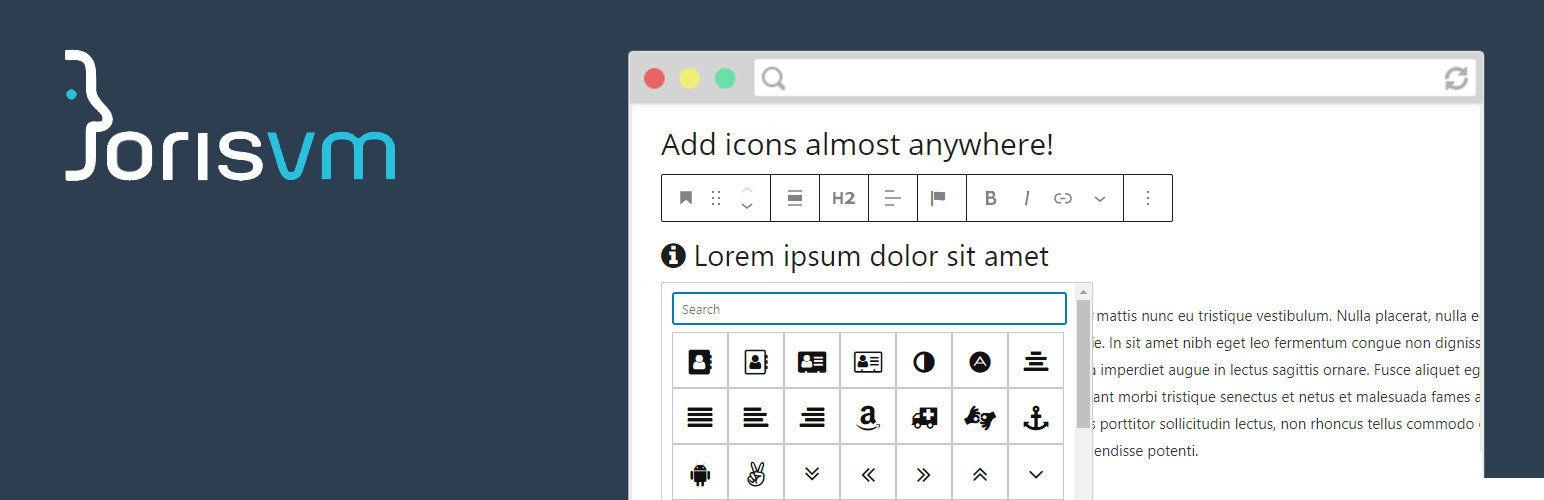
內容簡介
JVM Rich Text Icons 外掛可讓使用者在 WordPress 區塊編輯器的任何富文本欄位中插入圖示,提升內容的視覺吸引力與可讀性。
【主要功能】
• 圖示選擇器:從可搜尋的彈出視窗中選擇圖示
• 支援 Font Awesome:內建多個版本的 Font Awesome
• 自訂 SVG 圖示集:可上傳自訂 SVG 圖示以提升效能
• 單一圖示區塊:提供字型大小、顏色及對齊選項
• ACF 整合:為進階自訂欄位新增「JVM Icon」欄位類型
外掛標籤
開發者團隊
原文外掛簡介
Add icons to any rich text field in the WordPress block editor. Insert icons inline in paragraphs, headings, lists, buttons, or use the dedicated single icon block.
Features
Icon picker – Select icons from a searchable popup in the block editor toolbar.
Font Awesome included – Ships with Font Awesome 4.7, 5.x and 6.x. Choose your preferred version from the settings.
Custom SVG icon set – Upload your own SVG icons via a drag & drop uploader in the plugin settings. This is the recommended approach for the best performance.
Single icon block – A dedicated block with font size, color, alignment and spacing options. Supports Pattern Overrides (WordPress 6.9+), so the icon and its color can be customized per instance when the block is used inside a synced pattern.
ACF integration – Adds a “JVM Icon” field type for Advanced Custom Fields.
See it in action
How it works
Pick an icon from the toolbar while editing any rich text field. The plugin inserts a small HTML tag that gets styled by the chosen icon set.
Why use a custom SVG icon set?
When you use a custom SVG icon set, the plugin defaults to inline SVG rendering. This is a great choice for performance! Google PageSpeed Insights will thank you.
Better page speed – No render-blocking CSS or font files to download. Icons are part of the HTML itself.
Only loads what you use – Unlike Font Awesome which loads CSS for hundreds of icons, inline SVG only includes the icons that are actually on the page.
No external requests – Everything is served inline, so there are no extra HTTP requests for font or CSS files.
Inherits text color – Icons automatically use the surrounding text color, no extra CSS needed.
Fully reversible – The stored content in the database is not modified. You can switch between render technologies at any time from the plugin settings if you want to.
Alternative render technologies (CSS masks, ::before / ::after pseudo-elements) are also available for custom SVG icons if your use case requires it.
For developers
The plugin provides several filter hooks to customize its behavior. You can load your own icon set, CSS file, or change the icon class prefix.
Load a custom icon set file
add_filter( 'jvm_richtext_icons_iconset_file', function($file) {
return get_stylesheet_directory() . '/path_to_my/icons.json';
});
Load a custom CSS file
add_filter( 'jvm_richtext_icons_css_file', function($cssfile) {
return get_stylesheet_directory_uri() . '/path_to_my/cssfile.css';
});
To disable the default CSS file entirely:
add_filter( 'jvm_richtext_icons_css_file', '__return_false');
Change the icon class prefix
add_filter( 'jvm_richtext_icons_base_class', function() {
return 'my-custom-css-class-name';
});
Disable the settings screen
add_filter( 'jvm_richtext_icons_show_settings', '__return_false');
Please note that if you are loading a custom icon set with the plugin hook: jvm_richtext_icons_css_file, you should make sure the plugin is not set to My SVG uploads as this setting does not load any CSS file.