內容簡介
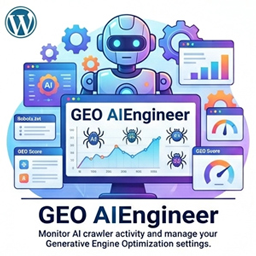
Goppa 是一款專為 WordPress 設計的 AI SEO 和 AI 可見性外掛,能夠追蹤 AI 爬蟲的訪問情況,快速提交變更的頁面至索引,並在 robots.txt 中聲明頁面可用於生成答案,提升網站的搜尋引擎優化效果。
【主要功能】
• 計算 AI 爬蟲訪問次數並顯示
• 透過 IndexNow 快速提交變更的 URL
• 在 robots.txt 中聲明內容信號
• 提供 WooCommerce 代理端點
• 自動應用 SEO 修正至指定外掛
• 將刪除產品的地址重定向至類別
外掛標籤
開發者團隊
② 後台搜尋「Goppa – AI SEO & AI Visibility: llms.txt, IndexNow, AI Crawlers」→ 直接安裝(推薦)
📦 歷史版本下載
原文外掛簡介
Goppa is an AI SEO and AI visibility plugin for WordPress. It shows you
which AI crawlers are reading your site, gets your changed pages into the
index those assistants answer from, states — in your own robots.txt — that
your pages may be used to build a generated answer, and, with a Goppa plan
with SEO, writes the SEO fixes you approve into your SEO plugin.
What Goppa does
Counts AI crawler visits on your site — GPTBot, ClaudeBot,
PerplexityBot, OAI-SearchBot, Google-Extended, Amazonbot, Applebot and
others — and shows the count on its own screen. The count is kept on
your server and nothing about it is sent anywhere.
Submits every changed URL through IndexNow, so Bing and Yandex
learn about your pages, posts and products in hours instead of weeks.
The verification key is generated and served automatically.
Declares Content-Signal: search=yes, ai-input=yes in robots.txt,
the line that says an AI system may use your page in a generated
answer. It never touches ai-train.
Serves four agent endpoints from a WooCommerce catalogue when one
is present: a UCP manifest, llms.txt, a live MCP server and your
catalogue as schema.org JSON.
Publishes a product summary and an FAQ as visible text, built only
from fields you already filled in. Both are off until you turn them on.
Applies fixes for you when a Goppa account is connected: llms.txt,
robots.txt rules for named AI crawlers, the sitemap reference and
missing product schema fields.
Writes the SEO fixes you approve (SEO title, meta description,
image alt text, category description) into Yoast SEO, Rank Math, All in
One SEO or SEOPress. Off until you turn it on. It fills empty fields,
and replaces text you wrote only when you approve that replacement;
undo puts your text back.
Keeps deleted products from becoming dead ends on a WooCommerce
shop: their address redirects (301) to the product’s category, and the
settings screen lists the addresses that answered “page not found”.
Off until you turn it on.
Sends nothing about you anywhere until you enter a token. The
crawler count stays on your server. IndexNow submits your own public
URLs, and nothing else, and can be switched off.
WooCommerce is optional. The crawler count, IndexNow and the Content
Signal work on any WordPress site. The catalogue endpoints and the
product feed check appear when WooCommerce is running.
The line nobody is declaring
Cloudflare switched the Content Signals format on across more than 3.8
million domains with ai-train=no and ai-input deliberately left
blank — they said they did not want to guess your preference.
ai-input is the one that means "you may use this page to build a
generated answer”. Millions of sites now say “do not train” and say
nothing at all about appearing in the answer, and a crawler that reads
blank as “no” quietly drops them from the answers they want to be in.
Goppa writes Content-Signal: search=yes, ai-input=yes. It leaves
ai-train alone — training a model on your content is a separate
decision, and yours. If your server or CDN already sets a Content
Signal, that one is left alone.
First, the page has to be findable
ChatGPT and Copilot answer shopping and research questions from Bing’s
index. A page outside that index cannot be recommended, however good its
structured data is. This is the part most tools skip, because it is not
a file you can generate.
A meta-analysis of 54 studies published in May 2026 puts URL
accessibility as the strongest single factor in whether an AI cites a
page — ahead of everything else on this list. That is why IndexNow is on
by default. Turn it off under Settings if another plugin already submits
your URLs.
Then it has to be readable
With WooCommerce running, four endpoints on your own domain, with no
configuration:
/.well-known/ucp — a UCP discovery manifest conforming to the
published specification, so an agent can find out what your store
offers.
/llms.txt — a plain-text description of your store, categories and
products for AI models.
/mcp — a live MCP server (JSON-RPC 2.0, protocol 2025-06-18) with
three tools: search_products, get_product and get_store_info.
/goppa/catalog — your catalogue as schema.org/Product JSON.
Products, prices, stock status, categories and attributes are read
directly from WooCommerce and cached for ten minutes. Search ignores
accents, so “tenis” finds “Tênis” and “fussball” finds “Fußball”.
It applies the fixes, not just the files
With a Goppa account connected, the plugin checks hourly for fixes found
by the diagnosis and applies them to your site itself — the llms.txt,
the robots.txt rules that let named AI crawlers through, the sitemap
reference, and product schema fields that are missing. Then it reports
back what it applied, so the diagnosis you see is the state of your site
and not a to-do list.
Two rules it never breaks:
It never changes what you wrote. Titles, descriptions, prices and
policies are on a refuse list inside the plugin. Even if the service
asked, this code would discard the instruction — the list lives here,
on your server, precisely so it holds regardless of what happens
upstream.
The plugin pulls; the service never pushes. Every connection is
outbound from your site, like the telemetry. No authenticated route is
opened on your WordPress.
Optional: removed products and pages not found
Off until you turn it on under Goppa → Settings → Removed products. When
a product goes to the trash, its address answers with a permanent
redirect (301) to the product’s main category, so Google and anyone with
the old link land somewhere useful instead of “page not found”. Restore
the product and its page comes back; turn the setting off and every
redirect stops at once. Out-of-stock products are not redirected: their
page stays.
The same setting counts the addresses on your site that answered “page
not found” — only the path, such as /old-product — and lists the most
requested ones on the settings screen.
Readable is not the same as recommended
Everything above makes your site readable. None of it can tell you
whether an assistant actually names you when someone asks what to buy or
who to use: that has to be measured by asking, from the outside.
In our own published research we measured 64 shops twice: a technical
readiness score, and whether AI assistants name them when asked real
buying questions in their category. 25 of the 32 shops scoring a perfect
100 appeared in 0% of the answers, and only 16 of 64 were named at all.
The median readiness score of the shops that are never named is 100. For
the shops that are named, it is 97. The invisible ones score higher.
It also varies enormously by category: 1 of 12 natural beauty shops
appeared; 4 of 12 electronics shops did. The data and method are public
at https://trygoppa.com/study
Anyone promising a specific outcome here is guessing. Serving these
protocols is a precondition, not a guarantee.
You can check where you stand without installing anything
Create a free account at https://trygoppa.com (no card) and run the free
check on your domain: it reads your site from the outside, gives you a
readiness score, and asks ChatGPT a real buying question in your category
to show whether it names you. The plugin is not required.
Install the plugin when you want the work done on your site instead.
What this does not do
It does not process carts, checkout or payments, and the UCP manifest
does not claim otherwise — it declares catalogue search and lookup,
nothing else. An agent that reads it will send the shopper to your site
to buy. Announcing a checkout that does not exist would make agents try
to transact and fail.
Optional: see what the agents actually do
Paste a token from a Goppa account and the plugin reports agent activity
— which endpoint was called, what was searched, which product was
returned. Never visitor data. This is off until you configure it; see
“External services” below.
External services
With no token configured, and unless you click Connect to Goppa, this
plugin makes no external connection carrying your data. The crawler count stays on your server. IndexNow,
when on, submits your own public URLs to https://api.indexnow.org —
the URL and your site’s verification key, nothing else.
If you enter a Goppa store token on the Goppa screen (it has its own item
in the admin menu), the plugin sends
agent activity to the Goppa service at https://trygoppa.com
(endpoint /api/ingest). This is what is sent, and only when an AI agent
requests one of the four endpoints above:
which endpoint was requested (for example mcp);
the User-Agent string sent by the agent, which the service classifies
into a known agent name;
which MCP tool was called (for example search_products);
the search term or product identifier the agent asked for;
the name of the product returned first.
Records are queued and sent after the response to the agent has already
been delivered, so the service being slow or unreachable never delays
your site. Nothing is sent about your human visitors: no IP addresses, no
customer or order data, no personal information. Clearing the token stops
it immediately.
The Connect to Goppa button. When you click it, your browser opens
https://trygoppa.com/connect with this site’s address, a one-time
request code and the address of this admin screen. Nothing is connected
until you sign in there and confirm. The plugin then sends that one-time
code, the request code and this site’s address to
https://trygoppa.com/api/connect/exchange, receives the store token and
saves it exactly like a pasted token. The token never appears in a
browser address.
Which Goppa settings are on. With a token connected, when the plugin
fetches its fixes from https://trygoppa.com/api/plugin/directives (once an
hour, and about 30 seconds after you save one of these settings), it also sends the plugin version and the names of the settings on
this screen that you turned on (for example faq_visivel or resumo), so
the Goppa app can show which setup steps are already done. Only the names
are sent: no content, visitor or order data.
SEO fixes (Goppa plans with SEO). With a token connected, once a day
the plugin sends to https://trygoppa.com/api/plugin/seo the list of
your public products, product categories, pages and posts: the address,
the title, the SEO title and meta description currently saved in your
SEO plugin, the first product category, a 400-character excerpt, the
number of products in each category, the address of product images
that have no alt text, whether each item is set to noindex in your SEO
plugin, whether the site asks search engines not to index it
(Settings → Reading), how many addresses Bing has accepted through
IndexNow so far, and the plugin version. The Goppa service uses it to write suggestions,
which you review in the Goppa app. When you approve a fix and the SEO
fixes setting is on, the plugin writes it into the field (an empty one,
or one whose replacement you approved) and reports back which fixes were
written. Hidden, draft and
password-protected content is never sent.
Sales and orders by channel (two settings, both off until you turn
them on; WooCommerce only). With a token connected, the plugin sends to
https://trygoppa.com/api/conversions, a minute after the order-received
page:
Sales an AI assistant took part in: for an order placed in the same
visit that arrived from ChatGPT, Perplexity, Claude or another
assistant, the name of that site (for example chatgpt.com), the
currency, the order total and a one-way code for the order. This one
keeps that name in the session WooCommerce already uses for the cart.
Orders by channel: for every order, the channel WooCommerce itself
recorded on it (for example google, bing, ai, paid, social or
direct), the currency, the order total and a one-way code for the
order. The name of a search engine or an AI assistant is sent; campaign
names and other referring sites are not. Nothing new is stored about
your visitors.
Never a name, email, address, IP address or the order number itself: the
one-way code exists only so the same sale is not counted twice.
Removed products and pages not found (0.15.0, off until you turn it
on). The redirects and the count stay on your server. Only when your
site is connected and the Goppa app requests the daily SEO inventory, the
plugin adds the number of redirected product addresses and the 20 most
requested paths that were not found in the last 30 days, each with its
count and the date it was last requested. Only the path of the address:
never the query string, the visitor, the IP address or the browser.
Product questions (0.12.0). Answers you write in the Goppa app come
to the plugin with the SEO fixes (so the SEO fixes setting must be on)
and are saved on the product. The plugin shows them on the product page
and lists them at /goppa/merchant-qa.xml, a public address on your own
site that Google Merchant Center can read. It contains only the product
IDs and the questions and answers already shown on your pages. Nothing
new leaves your site.
Service provided by Goppa — Terms of Service,
Privacy Policy.