
內容簡介
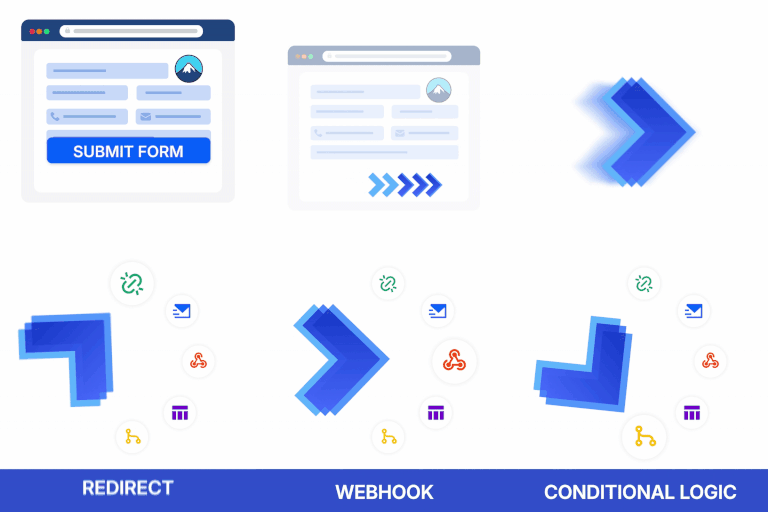
Page Redirection for Contact Form 7 外掛讓使用者在提交聯絡表單後,能夠靈活地重定向到指定頁面或外部網址,改善了聯絡表單的使用體驗,並提升了轉換率。
【主要功能】
• 自訂重定向頁面
• 支援外部網址重定向
• 設定重定向延遲時間
• 條件式重定向功能
• 直接推送資料至 Google Sheets、GoHighLevel 或 Slack
外掛標籤
開發者團隊
② 後台搜尋「Page Redirection for Contact Form 7」→ 直接安裝(推薦)
原文外掛簡介
Documentation | Support Forum
Contact Form 7 can redirect people after they submit, but only if you’re willing to write code. The redirect URL has to be hardcoded by hand, so a plain form leaves most site owners stuck with a small confirmation message and nothing more. No thank-you page, no next step, no handoff to the tools you actually run on. Page Redirection for Contact Form 7 fixes that.
Pick where visitors go after they submit and how they get there. Send them to a WordPress page, a custom post type, or any external URL. Add a short delay so they can read your confirmation first. Route different visitors to different destinations based on what they filled in. Show a polished popup or a toast notification instead of redirecting. You can even forward every submission to Google Sheets, GoHighLevel, or Slack the moment it happens. All of it is configured per form, right inside the Contact Form 7 screen you already use, and no code is required.
Best of all, every feature is free. There’s no locked “Pro” tier and no upsell. What you install is the whole plugin.
Plugin support for Contact Form 7 v5.8.1 and later.
Why You Need Page Redirection for Contact Form 7
A form submission is the start of something. A lead, a booking, or a sale. And Contact Form 7 leaves that moment hanging with a plain confirmation message. That’s a wasted opportunity every single time. Here’s where this plugin earns its place:
You want to send people to a proper thank-you page so you can track conversions in Google Analytics.
You need to hand form data off to a CRM or a landing-page builder that expects the values on arrival.
You want to send a visitor to a Calendly or Typeform link, in a new tab, without losing your page.
You want different form answers to route people to different follow-up pages.
You want new submissions pushed into Google Sheets, GoHighLevel, or Slack the moment they happen.
You’d rather show a friendly popup or toast message than send people away at all.
Without this, most of that means custom code or a developer. With it, it’s a few clicks in the form you already built.
Flexible redirection, set per form
Every Contact Form 7 form gets its own settings, so a donation form and a support form can behave completely differently.
Redirect to a page. Send visitors to any existing WordPress page or custom post type, like a dedicated Thank You page, straight from a dropdown.
Redirect to an external URL. Send visitors anywhere on the web. Paste the full address, including campaign links with UTM parameters for tracking.
Give visitors a moment before redirecting
Set a delay, in seconds, so your confirmation has time to land before the visitor leaves the page. Show an optional toast message during the wait, so the visitor knows the submission worked and a redirect is coming. Nothing ever feels frozen or broken.
Send different visitors to different pages (Conditional Rules)
Not every submission deserves the same follow-up. Conditional rules let you decide the destination based on what the visitor actually filled in.
Build as many rules as you need, based on any field in your form.
The Field dropdown lists your form’s fields automatically, so there’s no guessing.
Match with Equals, Not Equals, Contains, Does Not Contain, Is Empty, or Is Not Empty.
Rules run top to bottom, and the first match wins.
If nothing matches, your default redirect handles it as a fallback.
For example, a single contact form can send visitors who choose “Sales” to your sales page and visitors who choose “Support” to your support page.
Choose how the data is delivered
Standard redirect (GET). Normal browser navigation to the destination, the most widely compatible option. Pair it with query parameters if the destination page needs the submitted values.
Form Post (POST). Sends the submitted fields to the destination as a POST request, so the values arrive as form data and the destination URL stays clean. Ideal when a CRM or checkout expects a real form submission.
Open in a new tab. Keep the original form page open while the destination loads in a separate tab. Works with both delivery methods.
Pass form values through the URL (Query String Parameters)
When you use the standard redirect, you can carry submitted values to the next page so visitors never re-enter them. Pass all fields at once, or pick only the specific ones you need (say, just email and subject). Values are automatically encoded, so spaces, symbols, and international text never break the destination URL.
Send submissions to your other tools (Webhooks)
Normally a Contact Form 7 submission just sends an email. Webhooks let you also push that submission straight into another app the moment it arrives, with no forwarding and no copy-pasting.
Google Sheets. Log every submission as a new row for easy reporting.
GoHighLevel. Drop new leads straight into your workflows and pipelines.
Slack. Get instant lead notifications posted to the right channel, with a message template you control.
All three are built in and set up without code. Developers can add other services like HubSpot or Mailchimp using two simple WordPress filters, so the plugin can talk to almost any API.
Confirm submissions with a Popup
Prefer to keep visitors on the page? Show a polished popup the moment the form succeeds. Customize the icon, title, message, colors, footer, confirm and close buttons, and an optional auto-close timer.
Or show a Toast notification
For something lighter, a toast message slides in without blocking the page. Same customization as the popup, plus a position setting to place it anywhere: top, center, or bottom, and left, middle, or right.
List of Features
Enable/disable redirection per form, with its own redirect URL/page
Redirect to a Page, Custom Post Type, or external URL, including campaign links with UTM parameters
Conditional rules to redirect to a different destination based on a submitted field’s value
Redirect Method choice: Standard redirect (GET) or Form Post (POST), with an open-in-a-new-tab option for both
Query String Parameters to pass all or selected fields to the destination, with automatic encoding
Optional delay before redirect, with a message shown to the visitor while they wait
Built-in webhooks for Google Sheets, GoHighLevel, and Slack, plus developer filters for custom services
Customizable popup or toast notification shown after form submission instead of (or before) redirecting