內容簡介
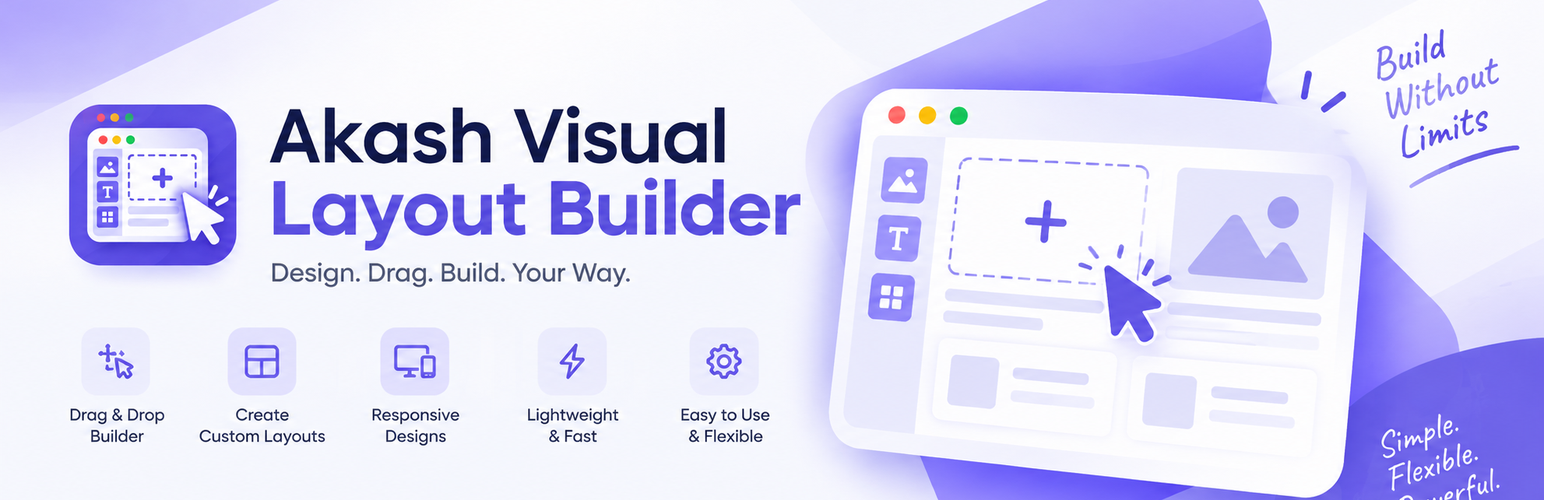
Akash Visual Layout Builder 是一款專為 WordPress 設計的視覺佈局建構器,讓使用者能夠輕鬆創建頁面、文章及彈出視窗,無需編碼或額外外掛,提供直觀的拖放介面。
【主要功能】
• 視覺建構器:支援響應式桌面、平板及手機編輯
• 網站佈局:全域標頭與頁尾設定
• SEO 面板:設定標題、描述、關鍵字及社交圖片
• 彈出視窗:使用視覺建構器創建彈出視窗
• SVG 資源庫:上傳並重複使用 SVG 資產
• 追蹤功能:整合 Google Tag Manager、GA4 等
外掛標籤
開發者團隊
原文外掛簡介
Akash Visual Layout Builder is a visual page builder for WordPress. After you activate it, you can create pages, posts, and popups using sections, columns, and widgets — no coding and no extra plugins required.
Features
Visual builder — sections, columns, and widgets with responsive desktop / tablet / mobile editing
Site layout — global header and footer
Page layout — per-page header and footer modes (inherit, append, replace, or none)
SEO panel — title, description, focus keyword, and social image
Popups — create and publish popups with the same visual builder
SVG library — upload and reuse SVG assets
Tracking (optional) — Google Tag Manager, GA4, Ads, and Meta Pixel IDs (no custom script pasting)
AI assistant (optional) — generate or improve page content through the WordPress AI Client when a provider is configured
The plugin is visual-only. Layout, popup, and page output is generated from the visual builder. Users cannot paste arbitrary HTML, CSS, JavaScript, or PHP.
Starter templates include local preview and section images. They do not load remote stock-photo CDNs.
How to use (fresh install)
Activate Akash Visual Layout Builder from the Plugins screen.
Open Akash Visual Layout Builder in the WordPress admin menu.
Go to Pages (or Posts), create a new item, or click Build with Akash Visual Layout Builder on an existing page/post.
Add sections, columns, and widgets on the live canvas. Use the desktop / tablet / mobile controls to check each breakpoint.
Open Layout to set header and footer behavior, then SEO for search and social metadata.
Save or publish. The page is live with no API keys or third-party accounts required.
Optional screens (all off until you turn them on):
Settings — editor defaults, permissions, optional Google Fonts, and optional AI
Tracking — GTM, GA4, Ads, or Meta Pixel IDs
Optional AI features
AI features are off by default. To use them:
Open Akash Visual Layout Builder → Settings and enable AI.
On WordPress 7.0 or later, install an AI provider plugin (Google, Anthropic, or OpenAI) and add its key under Settings → Connectors.
Those providers are third-party SaaS products. This plugin does not store their API keys. It sends prompts through wp_ai_client_prompt() only when AI is enabled and a site administrator has configured a connector. On WordPress 6.x, or when no provider is configured, the assistant uses local templates only.
Privacy
Tracking scripts are disabled until you enable them and enter IDs in the Tracking screen.
AI network requests only happen when AI is enabled and configured by a site administrator.
Google Fonts are disabled until you enable them in Settings.
The plugin does not load remote stock-photo CDNs.
External services
Akash Visual Layout Builder can connect to the third-party services below. Each connection is optional and off by default until a site administrator enables it. The plugin does not accept pasted tracking snippets; official vendor scripts are enqueued from the IDs you enter.
WordPress AI Client (optional AI content generation)
Why: to generate or edit visual-builder content when an editor uses Generate.
When: a site administrator enables AI in Akash Visual Layout Builder, WordPress 7.0+ has an AI provider configured under Settings → Connectors, and an editor submits a Generate request.
Data sent: the editor prompt, page title, and the current page content needed to apply the change. The request is made from your WordPress server through Core’s AI Client to whichever provider the site owner connected (typically Google, Anthropic, or OpenAI). Visitor browsers do not call those APIs.
Provider plugins: AI Provider for Google, AI Provider for Anthropic, AI Provider for OpenAI
Terms of Service: Gemini API terms, Anthropic terms, OpenAI terms
Privacy Policy: Google Privacy Policy, Anthropic privacy, OpenAI privacy
Google Fonts (optional webfonts)
Why: to load the font families selected in a design so published pages and the editor preview can render those typefaces.
When: a site administrator enables Load Google Fonts in Akash Visual Layout Builder → Settings, and a design uses those families.
Data sent: the font family names in the stylesheet URL. The visitor’s (or editor’s) browser then requests CSS and font files from Google, which receives standard request data such as IP address and user agent.
Terms of Service: Google Fonts terms
Privacy Policy: Google Privacy Policy
Google Tag Manager (optional tracking)
Why: to load the site owner’s GTM container so they can manage marketing/analytics tags.
When: a site administrator enters a GTM container ID on the Tracking screen and tracking is enabled for that page.
Data sent: the GTM container ID. Google’s gtm.js then collects page-view and related visitor data according to the container’s tags (typically page URL, referrer, and browser information).
Terms of Service: Google Tag Manager terms
Privacy Policy: Google Privacy Policy
Google Analytics 4 (optional tracking)
Why: to measure traffic and events on pages the site owner chooses.
When: a site administrator enters a GA4 measurement ID on the Tracking screen and tracking is enabled. (If GTM is also set, GA4 is expected to be loaded from the GTM container instead of a second gtag snippet.)
Data sent: the GA4 measurement ID, plus standard Analytics data such as page URL, referrer, and browser information collected by Google’s gtag script.
Terms of Service: Google Analytics terms
Privacy Policy: Google Privacy Policy
Google Ads (optional conversion tracking)
Why: to load Google Ads conversion tracking when the site owner enters an Ads ID.
When: a site administrator enters a Google Ads ID on the Tracking screen and tracking is enabled, and GTM is not already loading gtag.
Data sent: the Ads ID, plus standard conversion/page-view data collected by Google’s gtag script.
Terms of Service: Google Ads terms
Privacy Policy: Google Privacy Policy
Pexels (not used)
Why listed: starter photos used to be loaded from Pexels in earlier builds. This plugin no longer contacts Pexels.
When: never. Template and AI image slots use JPEG files shipped in assets/images/templates/. Remote stock-photo URLs are not requested.
Data sent: none. No visitor or editor data is sent to Pexels.
Terms of Service: Pexels terms (not applicable; the service is not called)
Privacy Policy: Pexels privacy (not applicable; the service is not called)
Meta Pixel (optional tracking)
Why: to load the official Meta Pixel when the site owner enters a Pixel ID.
When: a site administrator enters a Meta Pixel ID on the Tracking screen and tracking is enabled.
Data sent: the Pixel ID, plus standard pixel events Meta collects on page views.
Terms of Service: Meta terms
Privacy Policy: Meta Privacy Policy
Source code
The public repository is Akash Visual Layout Builder on GitHub. Compiled editor assets are shipped in assets/build/. The React/TypeScript source is included in the editor/ directory of this plugin.
Development
Repository: https://github.com/akash5052/Akash-Visual-Layout-Builder
Editor UI source: editor/ (build with npm install && npm run build inside that folder).
Packaging helper: ./package.sh (development only; not required on production sites).