內容簡介
AI Flash Tune 是一款專為 WooCommerce 設計的外掛,旨在幫助商家挽回放棄的購物車,並提供漏損銷售的分析。透過自動發送提醒郵件和詳細的儀表板,商家能夠有效提升轉換率,並了解顧客行為。
【主要功能】
• 自動發送最多三封提醒郵件
• 提供購物車恢復按鈕,方便顧客回到購物車
• 儀表板顯示銷售漏損和轉換率分析
• 支援多語言提醒,適應不同顧客
• 識別來自 AI 助手的流量,並進行分析
• 可選擇的訂閱取消連結,保護顧客隱私
外掛標籤
開發者團隊
② 後台搜尋「AI Flash Tune – Abandoned Cart Recovery & Funnel Analytics for WooCommerce」→ 直接安裝(推薦)
原文外掛簡介
Win back abandoned carts for free, and see where your WooCommerce store loses sales.
AI Flash Tune emails shoppers who left their cart, puts the cart back with one click, and counts every order it wins back. A dashboard shows where the rest of the money leaks (product pages, the cart page or checkout) and what to change first.
It also gets the store ready for shoppers who now start in ChatGPT, Gemini or Perplexity: it shows who those assistants send and whether they buy, keeps bots out of your numbers, and checks that AI assistants can read your products.
All of it is free: no limit on carts or emails, no “powered by” line in your emails, no account to create, and no upgrade pop-ups.
Abandoned cart recovery, included
Up to three reminder emails per cart (1 hour, 1 day and 3 days after the cart was left, by default), in your WooCommerce email design. Change every word and the timing, preview them, or send yourself a test.
Each email shows the cart and a “Return to your cart” button that puts the items back on any device and opens checkout.
An optional one-time coupon in any reminder, valid only for that shopper and applied for them.
Reminders stop as soon as the shopper orders. An order after a reminder counts as recovered revenue, and you get an email when it happens.
The checkout email is saved as it is typed, on classic and block checkout, so carts left half-way through checkout can be reminded.
A “Save my cart” box on the cart page and an optional popup when a shopper is about to leave, so shoppers who never reach checkout can leave an email too. Both are off until you turn them on.
WhatsApp: when a shopper typed a phone number, one click opens WhatsApp with your message and their cart link. You press Send.
Reminders go out in the shopper’s language. The default texts come in 23 languages.
Opens, returns to the cart, recovered orders and recovery rate for any period, and the full history of each cart.
An “Are emails going out?” check: the last and next run, emails sent and failed today, and what to do when WordPress’s scheduled tasks are not running.
A never-remind list for your team, test orders or wholesale buyers (emails, whole domains or IP addresses).
An unsubscribe link and header in every email, a “No thanks” link at checkout, and support for WordPress’s personal data export and erase tools.
Switching from Cart Abandonment Recovery (CartFlows), Abandoned Cart Lite or FunnelKit Automations? Bring over their open carts and every address that unsubscribed, in one click.
See where the money leaks
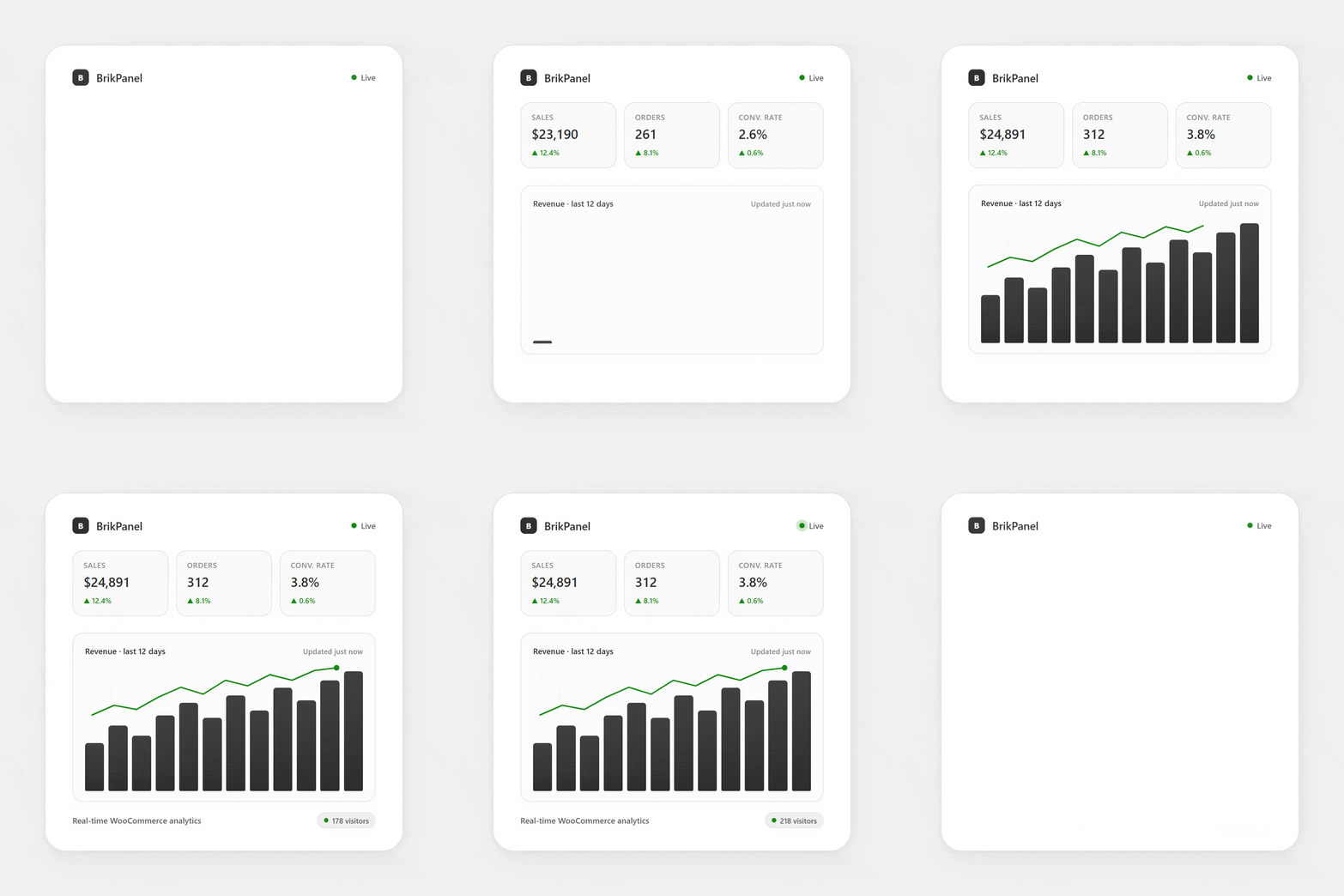
A dashboard with revenue, orders, average order, conversion, money left in carts and money won back, visits and orders per day, devices, and where shoppers stop.
The biggest leak, with what to change for it. Settings the plugin can change for you have a “Do it” button with Undo, and 14 days later the dashboard shows the rate before and after.
Funnel, Products, Carts and Checkout pages with plain-language hints, client reports and a weekly summary email.
Ready for AI shoppers
Visits sent by ChatGPT, Gemini, Perplexity, Copilot, Claude and other assistants are recognised, remembered on the order, and compared with everyone else in Funnel.
“Ready for AI shopping” on the dashboard: can AI assistants read the store, which products lack what AI shopping answers need (description, image, price, brand, barcode, reviews), and are returns and delivery clear.
Bots, scripts and AI fetchers are kept out of your visits and your cart list.
Optional review requests after the order, because reviews are what shoppers and AI answers look for.
Ask ChatGPT or Claude about your store: switch it on and AI apps you connect with your own login can read the reports (totals only, read-only).
Optional AI
The plugin works with your store’s own data and never needs an AI key. If you want written explanations and action plans, connect OpenAI, Claude or Zywrap in Settings.
AI Flash Tune is built around one principle:
Do not guess. Use store signals. Show confidence. Recommend safe, reversible improvements.
Everything else in the free plugin
Dashboard
Leak Scan opens with the numbers that matter for the period you pick (7, 30 or 90 days): revenue, orders, average order, conversion, money left in carts and money recovered. It shows visits and orders per day, where shoppers stop, how phones compare with computers, and the biggest leak with the few changes most likely to fix it. When there is too little data, it says so instead of guessing.
Funnel
Product views, add to cart, checkout and orders, with the drop-off between each step. Compare phones with computers, or new with returning customers, side by side.
Products
How each product sells: visits, add-to-cart rate, orders and conversion against your store average, with Leaking, Weak, Good and Needs data filters. Each product page shows its own funnel and a plain-language hint about its weakest step.
Checkout
Counts the fields shoppers have to fill in on classic and block checkout, and flags friction such as forced account creation.
Reports
A client-ready report (HTML or CSV) for any period, a weekly summary email, and a change history of everything AI Flash Tune changed, with Undo.
Tracking you can trust
A small first-party script records product, cart, checkout and order steps. It adds no database queries to page loads, makes no third-party requests and works with page caching. Admins and shop managers are left out by default, and tracking can wait for visitor consent.
Privacy tools
IP anonymisation, data retention, excluded roles and IP addresses, delete-on-uninstall, and WordPress’s personal data export and erase tools.
Optional AI Modes
AI Flash Tune supports local insights and optional external AI modes where available.
Local Mode
Local Mode uses private, rule-based insights from data stored on the site.
No OpenAI, Claude or Zywrap request is made in Local Mode.
This keeps the base plugin useful even when the store owner does not want to connect an external AI provider.
OpenAI Mode
OpenAI Mode uses the site owner’s OpenAI API key to write explanations, summaries and action plans (funnel, products, checkout, carts, weekly summary) from sanitized store totals.
Claude Mode
Claude Mode uses the site owner’s Anthropic API key to write the same explanations, summaries and action plans with Claude (Claude Haiku 4.5 by default, or Claude Sonnet 5), from sanitized store totals.
Zywrap Mode
Zywrap Mode uses the site owner’s Zywrap key and ready-made WooCommerce prompts for the same answers, written from sanitized store totals.
Zywrap requests include the selected AI response language when configured.
AI Response Language
AI Flash Tune includes an AI Response Language setting for OpenAI, Claude and Zywrap output.
By default, AI response language can follow the WordPress/admin language. Store owners can choose a specific response language in settings when they want reports, summaries, and AI guidance in another language.
Product names, metrics, URLs, code values, WooCommerce paths, and admin screen names should remain unchanged where appropriate.
AI Flash Tune Pro
Everything above works in this free plugin, without a licence or an AI key. That includes all of the cart recovery.
AI Flash Tune Pro is a separate plugin, sold and installed from aiflashtune.com ($79 a year for one store, $129 a year for up to 5 stores, $199 a year for up to 25 stores). It adds, inside the same pages:
WhatsApp and SMS cart reminders, sent automatically to shoppers who agree at checkout (with your own Meta or Twilio account)
Revenue Watchdog: an email the moment orders, checkout, payments, tracking or reminders stop working
AI included: AI answers without your own API key, with a monthly allowance
A second subject line test for reminders, and bigger coupons for bigger carts
White-label client reports, an AI checkout review, product copy with Undo, and one ranked Action Plan
This free plugin does not install, update or unlock Pro, and it never contacts the AI Flash Tune licence or update servers.
Privacy and Data Safety
Cookie and visitor consent
Frontend tracking sets one first-party cookie, aiflt_session_id, holding a random visit ID for up to 30 days. It is used only to group one visitor’s page views, cart and checkout steps in the store owner’s own database.
Turn on “Wait for visitor consent before tracking” in Settings & AI Keys if your visitors are in the EU or UK. Nothing is then recorded until the visitor accepts statistics cookies in a consent banner that supports the WP Consent API (for example Complianz or CookieYes). Sites with another consent tool can answer through the aiflt_has_tracking_consent filter.
For guests, the checkout email address is stored with the visitor’s own session once it is typed, so an abandoned cart can be recognised as recoverable. Tools > Export Personal Data and Tools > Erase Personal Data cover both registered customers and guests.
Cart reminders
When reminders are on, AI Flash Tune keeps, for each cart it may remind: the shopper’s email and first name, the cart contents and value, the language of the page, and the phone number if one was typed at checkout. Reminder emails contain a 1×1 image that records when an email is opened (approximate, since many email apps block images) and links that record when the cart is opened. Addresses that unsubscribe are kept only as a one-way hash, so they are never emailed again. Finished reminders are deleted after the tracking retention period, and never kept less than 90 days so reports stay complete. Tools > Export Personal Data and Erase Personal Data include this data.
The WhatsApp button never sends anything by itself: it opens WhatsApp with the message written, and the store owner decides whether to send it.
AI Flash Tune is designed to use local and aggregate store signals wherever possible.
Before external AI calls, payloads are intended to be sanitized and limited to the information needed for the selected AI action.
Examples of data that can be used for AI guidance:
Total sessions
Product views
Cart count
Checkout count
Purchase count
Abandoned cart count
Checkout field count
Page-speed signals
Product performance summary
Anonymous segment comparison
Store configuration signals relevant to the selected action
Examples of data that should not be sent to AI providers by default:
Customer names
Customer emails
Phone numbers
Billing addresses
Shipping addresses
IP addresses
Payment details
Private order notes
Passwords
Tokens
API keys
Unnecessary personal data
AI Flash Tune recommendations should be reviewed before applying changes.
Checkout settings, product copy, recovery emails, pricing, payment providers, shipping promises, discounts, trust badges, urgency tactics, and other conversion-sensitive changes should not be changed unless the store owner has reviewed the recommendation and the available data supports that action.
External Services
AI Flash Tune does not contact any server of its own. It has no licence check, no update check and no usage reporting. The only external requests it can make are to the AI provider the site owner configures below.
AI Flash Tune can connect to external AI services only when configured and enabled by the site owner.
If external AI features are not configured, local insights can continue to work without OpenAI, Claude or Zywrap.
OpenAI
OpenAI Mode may send sanitized store signals and prompt context to OpenAI’s API for AI-generated explanations, summaries, and recommendations.
Used for features such as:
Funnel explanations
Action plans
Product diagnosis
Checkout analysis
Cart recovery guidance
Weekly summaries
AI report generation
Data sent may include:
Sanitized store metrics
Aggregate funnel, product, cart, checkout, and performance signals
Selected report/action context
User-provided prompt/context if the user enters one
OpenAI terms and privacy information:
https://openai.com/policies/
https://openai.com/policies/privacy-policy/
Claude (Anthropic)
Claude Mode may send sanitized store signals and prompt context to Anthropic’s Messages API (https://api.anthropic.com/v1/messages) for the same AI-generated explanations, summaries and recommendations as OpenAI Mode. It is used only when the site owner picks Claude, saves their own Anthropic API key and allows sending store totals, and only when an AI answer is asked for.
Data sent may include:
Sanitized store metrics
Aggregate funnel, product, cart, checkout, and performance signals
Selected report/action context
User-provided prompt/context if the user enters one
Anthropic terms and privacy information:
https://www.anthropic.com/legal/commercial-terms
https://www.anthropic.com/legal/privacy
Zywrap
Zywrap Mode may send sanitized store signals, wrapper codes, selected language, structured variables, and optional user-provided prompt context to the Zywrap proxy endpoint.
Used for predefined AI Flash Tune ecommerce conversion workflows such as:
Next-best-action prioritization
Product copy optimization
Checkout friction audit
Cart recovery sequence planning
Abandoned cart reason analysis
Store performance summaries
Structured ecommerce conversion guidance
Data sent may include:
Sanitized store metrics
Aggregate funnel, product, cart, checkout, and performance signals
Selected wrapper/action payload
Selected AI response language
Structured variables required for the selected action
User-provided prompt/context if the user enters one
Zywrap service information:
Website: https://www.zywrap.com
Terms: https://www.zywrap.com/terms
Privacy: https://www.zywrap.com/privacy
Credits
Admin icons: Lucide (https://lucide.dev), ISC License.