內容簡介
AI Blackout 外掛旨在阻止 AI 爬蟲抓取您的網站內容,保護您的創作不被未經授權使用,並確保您的網站流量與收益不受影響。
【主要功能】
• 阻擋 26 種 AI 爬蟲
• 提供正式法律通知
• 內建三層阻擋機制
• 確保 Google 流量不受影響
• 簡單設置,只需回答一個問題
外掛標籤
開發者團隊
② 後台搜尋「AI Blackout – Block AI Crawlers & Stop AI Training」→ 直接安裝(推薦)
原文外掛簡介
AI companies are copying your content to train their chatbots. Nobody asked you, and nobody paid you.
A crawler takes your writing. Later someone asks a chatbot a question, gets an answer built out of your work, and never visits your site. You lose the traffic, the ad view, the sale, the signup.
Most site owners have no idea it is happening. No email, no warning, nothing in your dashboard.
AI Blackout shuts the door. Install it, answer one question, done.
What you get
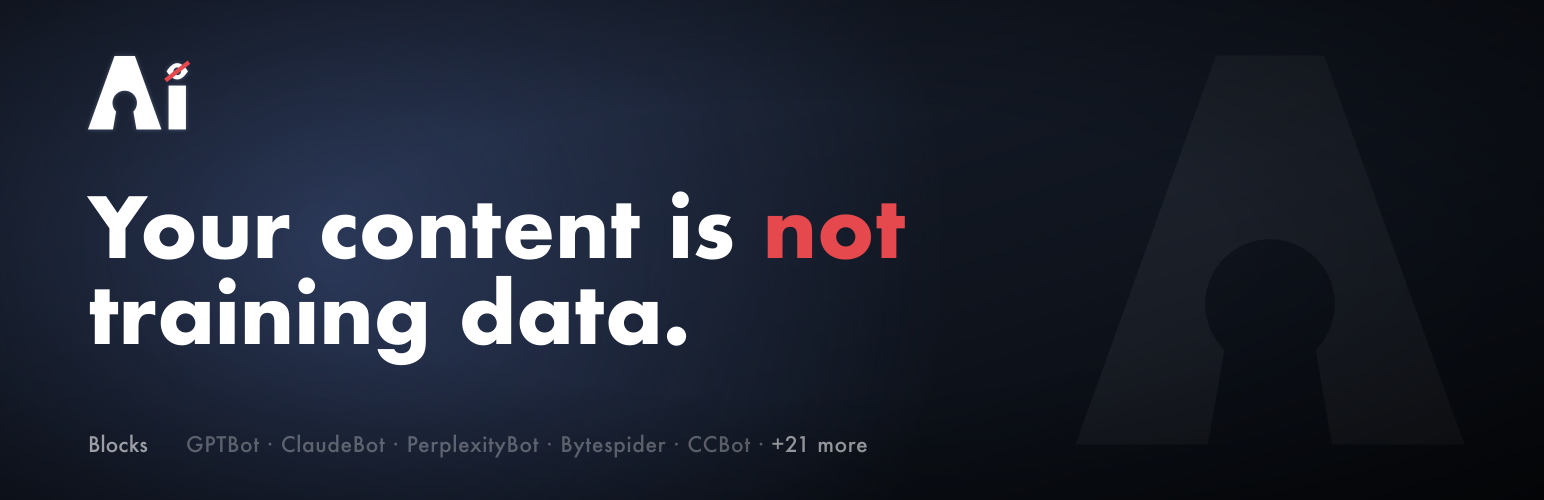
26 AI crawlers blocked. OpenAI, Anthropic, Google, Meta, ByteDance, Perplexity, Amazon, Apple, and the dataset scrapers that feed everyone else.
Your refusal on the record. A formal legal notice that your work is not free to train on, published where AI companies look for it.
AI switched off inside WordPress. Core’s AI, the AI your plugins keep adding, and anything on your site trying to reach an AI company.
Google traffic untouched. Search engines are protected by design, not by you being careful.
Proof it works. The plugin asks your own site for a page while pretending to be a crawler, then shows you exactly what it got.
Setup is one question
Simply pick one:
Block AI from taking my content. Refuses training and scraping crawlers, leaves AI search alone so people can still find you. Most people want this one.
Block everything AI. Also refuses the crawlers behind ChatGPT, Claude and Perplexity search. Ordinary search engines are still allowed.
Just state my terms. Blocks nobody. Publishes your legal position and asks, in robots.txt, that your work is not used for training.
Press Save. The plugin writes every layer your server can take. No apply button, no second screen. Change your answer later and it rewrites everything to match.
Your Google ranking is safe
Getting dropped from Google is the worst thing a plugin like this could do to you, so it is prevented by design rather than by good intentions.
Googlebot and its seven siblings, Bingbot, Yahoo, DuckDuckGo, Baidu, Yandex, Applebot and the Facebook, X/Twitter and LinkedIn preview bots sit on a protected list of 18 identifiers. Every rule is tested against that list before a byte is written, and anything that would catch one of them is thrown away.
A few AI crawlers do affect whether you show up in AI answers. Those are flagged on their own row, and blocking one takes a separate confirmation.
Three layers of blocking
The plugin tells you which ones are actually live on your server instead of assuming all three are.
robots.txt. A polite request. Honest crawlers obey it.
WordPress. Your site refuses the request itself.
Your web server. On Apache and LiteSpeed, crawlers are turned away before WordPress or your cache is involved. This is the strongest layer.
Your rights, in writing
Blocking stops the well-behaved crawlers. A declaration removes everyone else’s excuse.
A reservation of rights under Article 4(3) of the EU copyright directive, at the address AI companies check.
Content Signals in robots.txt, separating “you may index this” from “you may train on this”.
Meta tags for the crawlers that read those instead.
A matching clause for your terms page, written for you.
It keeps a dated record of every wording you have published, so you can answer “since when?” about your own site. One click sends your robots.txt to the Internet Archive for a timestamped copy.
Getting AI out of your WordPress
WordPress 7.0 shipped with AI in core, and your plugins keep adding more of it.
Turn off core’s AI and close the interface that lets AI agents act on your site.
Hide the screen where AI provider keys get entered.
Strip the AI out of Elementor and Yoast SEO using their own off-switches. Nothing is written into their settings.
Log every request your site makes to an AI company: which plugin, where to, how often. It watches by default and blocks only when you say so.
What it cannot do
This part matters more than the feature list, so please read it.
It cannot stop a crawler pretending to be an ordinary browser. Nothing running on your server can. Blocking works because honest crawlers say who they are.
robots.txt is a request, not a barrier. A crawler that ignores it is unaffected. This plugin never counts robots.txt as protection or shows it to you as though it were.
On nginx it cannot write server rules. nginx config lives outside your site folder and needs root and a reload, so no WordPress plugin can touch it. This one writes the rule out for you with the message to send your host. Any plugin claiming to block crawlers at server level on nginx is not telling you the truth.
A declaration is a legal position, not a lock. It does not physically stop anyone. It removes their excuse.
Nothing is sent anywhere
The crawler list ships inside the plugin and updates when the plugin does.
AI Blackout makes no external requests of any kind. No account, no licence key, no analytics, no remote ruleset, no “anonymous usage data”. The only request it ever makes is to your own site, when you press Test it from the outside.
Your files stay yours
The plugin writes robots.txt and, on Apache or LiteSpeed, .htaccess. It writes them when you save, so what is on disk always matches what the screen says.
Everything goes between its own markers and nothing outside them is touched. Removing it puts the file back byte for byte, and tells you plainly if something else edited the file in the meantime.
Deactivating the plugin removes the rules it wrote. A blocking rule with no plugin managing it is a booby trap, and it would make “deactivate this and see if it was the cause” give you the wrong answer. Your settings and your dated record stay exactly where they are.
Not affiliated with anyone named here
AI Blackout is an independent plugin by LazyCodeLab, not affiliated with or endorsed by any company it names. OpenAI, Anthropic, Google, Elementor, Yoast SEO and the rest appear only to identify whose crawler is being blocked or whose AI feature is being switched off. All marks remain the property of their owners.