內容簡介
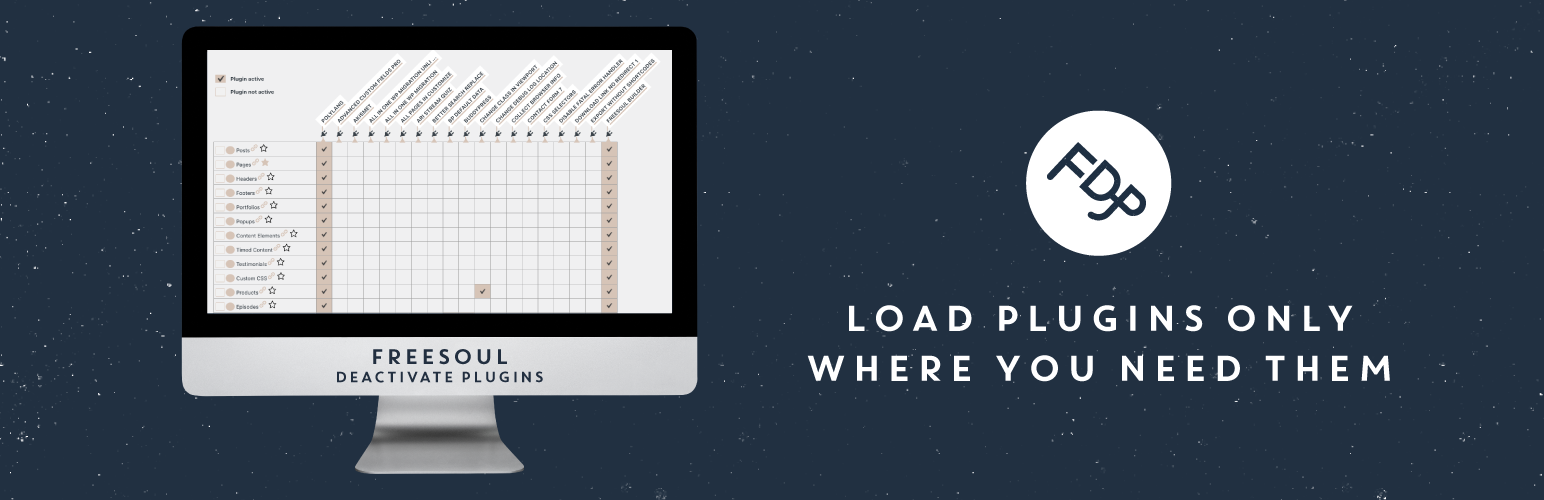
FDP 可讓您在特定頁面上停用外掛程式,以進行速度優化、偵錯和解決問題。它可適用於所有頁面、文章、定製文章(可公開查詢)、歸檔和後端頁面。
使用 FDP,您可以停用不需要的所有外掛程式,這不僅可以清除第三方外掛程式的資產,也不會運行它們的 PHP 代碼。因此,您的頁面將有較少的 HTTP 請求和較少的資料庫查詢。在未經快取的情況下,您還可以改善 TTFB(首字節時間)。
通常,特定頁面所需的外掛程式數量低於全局活動外掛程式數量。為什麼不只在需要它們的頁面上保留外掛程式呢?
大多數外掛程式在所有頁面上載入其資產並查詢資料庫,無論它們是否有用途。這通常會導致性能變差。使用 FDP,無論您有多少外掛程式,都可以將它們保持活動狀態,只在需要它們的地方使用。
使用 FDP 預覽某些特定外掛程式載入的頁面,這非常有用於檢測哪個外掛程式會導致問題。如果在特定頁面上只保留你真正需要的外掛程式,大多數情況下,外掛程式之間發生衝突的概率更低。
免費版本的 FDP 功能如下:
- 在特定頁面、文章、定製文章、歸檔、搜尋結果頁面、裝置上停用外掛程式
- 停用特定後端頁面的外掛程式和主題
- 在前端預覽停用 JavaScript 執行以解決問題
- 在前端和後端通過自定義 URL 停用外掛程式
- 自動建議無用的外掛程式
- 更改外掛程式啟動順序
- 快速創建功能外掛程式
- 導入/導出喜愛的外掛程式列表
- 預覽在特定外掛程式停用和切換到另一個佈景主題時的頁面,而不影響公共站點
- 預覽使用 Google Page Speed Insights 的評分,針對單個文章、頁面和定製文章進行評分(快取預覽下,無快取可能評分較低,請用於參考目的)。
外掛標籤
開發者團隊
② 後台搜尋「Freesoul Deactivate Plugins – Disable plugins on individual WordPress pages」→ 直接安裝(推薦)
📦 歷史版本下載
原文外掛簡介
Load plugins only where you need them. No bloat, no conflicts, more speed. Deactivate plugins where they don’t add anything useful.
Disable plugins on individual WordPress pages
FDP allows you to deactivate plugins on specific pages for speed optimization, debugging and problem-solving.
It works for every page, blog posts, custom posts that are publicly queryable, archives and backend pages.
Turning off plugins selectively can improve the performance, but also solve conflicts between plugins.
For large or business-critical WordPress sites, using FDP is not just an optimization — it is an essential part of a clean, high-performance architecture.
🚀 Deactivate plugins on specific pages to improve the performance
With FDP you can disable the entire plugins where you don’t need them. It will not only clean up the assets of third-party plugins, their PHP code will not run either. Hence, your pages will have fewer HTTP requests and fewer database queries.
You will improve the TTFB (time to first byte) also when the page is not served by cache.
Usually, the number of the needed plugin on a specific page is lower than the number of globally active plugins.
Why don’t you keep the plugins active only on the pages where you need them?
Most of the plugins load their assets and query the database on all the pages, no matter if they do something useful. This causes many times a worsening of the performance.
With FDP no matter how many plugins you have, you can keep them active only where you need them.
🧹 How to stop a plugin on specific WordPress pages
Watch this video to have an overview of how to clean up your website with Freesoul Deactivate Plugins.
🥊 Deactivate plugins on specific pages to solve conflicts between plugins
With FDP you can preview the page loading specific plugins. This is very useful to detect which plugin is causing issues.
Look How to check which plugin is causing issues in 1 minute for more details.
If on a specific page you keep active only the plugins that you really need, most of the time the probability of having conflicts between plugins is lower.
🆓 Features of the free version. With the free version of FDP you can:
⭐ Conditional plugin loading
⭐ Deactivate plugins on specific pages, posts, custom posts, post types, archives, term archives, search results page, devices
⭐ Deactivate the JavaScript execution for problem solving (preview on front-end)
⭐ Deactivate plugins by custom URL on the frontend
⭐ Have an automatic suggestion about the unused plugins for the homepage
⭐ Change plugins firing order
⭐ Create a functional plugin in no time
⭐ Import/Export list of favourite plugins
⭐ See a preview of the pages deactivating specific plugins and switching to another theme without affecting the public site
⭐ See a preview of the page with Google Page Speed Insights for single posts, pages and custom posts (preview without cache, the page may give lower score without cache, use it for comparisons during the optimization)
and much more.
👑 Features of the PRO version. The premium version also includes:
⭐ Unused plugins automatic suggestion both for frontend and backend
⭐ Unused plugins automatic check after content update
⭐ Recording of Ajax activities to find out on which Ajax action you need to disable specific plugins
⭐ Recording of Post activities to find out on which Post action you need to disable specific plugins
⭐ Rest APIs cleanup
⭐ Translated URLs cleanup
⭐ Cron Jobs cleanup
⭐ General bloat deaactivation
⭐ Options autoload management
⭐ Stylesheests and scripts deactivation of remaining active plugins, theme and core
⭐ Import/Export FDP settings
⭐ Bulk actions to activate/deactivate plugins in the FDP settings
⭐ Deactivate plugins in the backend
⭐ Deactivate plugins by custom URL on the backend
⭐ Plugins deactivation by logged and unlogged user
⭐ Automatic GTMetrix and Google PSI reports generation
🧹 📱 Clean up on mobile
FDP allows you to disable specific plugins for mobile devices. But if you disable a plugin on mobile, that plugin will be disabled on all the pages on mobile.
If you want to selectively disable plugins on mobile pages, you can install Specific Content For Mobile that is fully integrated with FDP.
If you create mobile versions with SCFM, you will find the mobile pages in the FDP Singles settings. There you can disable plugins as you do with normal desktop pages.
FDP and SCFM together are powerful tools to selectively clean up mobile pages.
If you clean up the mobile, remember to set up your caching plugin to separate the desktop and mobile cache, in another case you may have issues.
For instance W3 Total Cache, WP Fastest Cache, Powered Cache, and LiteSpeed Cache are caching plugins that can serve a different cache on mobile.
⚠ Requirements
Only the permalink structures “Day and name”, “Month and name”, “Post name” and the custom ones ending with “%postname%” are supported for permanently deactivating plugins (they are also better for SEO).
You will not be able to disable plugins in a permanent way with other permalink structures.
The same if you are using plugins to change the permalinks, e.g., Permalink Manager Lite.
🔌 FDP add-ons
🔌 Freesoul Deactivate Plugins PRO
🔌 Editor Cleanup For Oxygen
🔌 Editor Cleanup For Elementor
🔌 Editor Cleanup For Avada
🔌 Editor Cleanup For WPBakery
🔌 Editor Cleanup For Divi Builder
🔌 Editor Cleanup For Flatsome
🚀 Recommended plugins to use in conjunction with FDP to improve performance
🔌 Caching plugins: W3 Total Cache, WP Fastest Cache, WP Optimize, Comet Cache, Cache Enabler, Hyper Cache, WP Super Cache, LiteSpeed Cache, SiteGround Optmizer. All of those caching plugins are compatible with Freesoul Deactivate Plugins. If your favorite caching plugin is not compatible for any reason, let us know it.
🔌 Plugins to convert WebP like: WebP ConverterrFor Media, Imagify – Optimize Images & Convert WebP, Smush, WebP Express, ShortPixel, TinyPNG. All those plugins to convert WebP are compatible with Freesoul Deactivate Plugins. If your favorite WebP converter plugin is not compatible with FDP, let us know.
🔌 Lazy loading videos is not enough if they are near the viewport. For loading videos on click, you can use Load Video On Click
🔌 Inline the first image that appear in the viewport directly to the HTML if it’s not too big with Inline Image Base64
FDP is compatible with all optimization plugins. If your favorite plugin isn’t in the list above, and it gives conflicts, don’t hesitate to open a thread on the support forum.
🖤 Recommended plugins to use in conjunction with FDP for plugins management
🔌 PlugVersions: Easily rollback to previous versions of your plugins
🔌 Rename Plugins Folder: Rename the plugins folder to add a layer of protection to your website.
🚫 Plugins not compatible with Freesoul Deactivate Plugins
🔌 Domain Mapping System: It loads Freemius on the frontend and this may cause the unexpacted deactivationg of some plugins.
🔌 Admin Menu Editor: It gives you the possibility to customize the admin menu. If you disable plugins on the backend pages, this plugin is not compatible with FDP.
𐧺 Multisites
If you have a Multisite Installation, in every single site you will be able to manage only the plugins which are active on that site. FDP will not see those plugins that are globally active in the Network. And you have to activate FDP on every single site, not globally on the Network.
❓Frequently Asked Questions
Here you will find the frequently asked questions.
🔐 How can I report security bugs?
You can report security bugs through the Patchstack Vulnerability Disclosure Program. The Patchstack team helps validate, triage, and handle any security vulnerabilities. Report a security vulnerability.
🛟 Help
Read 📄 how deactivate plugins on specific pages to learn how to selectively load only the plugins that you really need.
For any question or if something doesn’t work, don’t hesitate to open a thread on the support forum
Enabling debugging in wp-config.php is often one of the easiest ways to diagnose issues in WordPress. It helps you understand what’s going wrong by displaying error messages and logs.
Need a step-by-step guide? Read this detailed tutorial on how to enable debugging in WordPress to learn more.
Documentation
For detailed guides and performance optimization tips, please refer to our official documentation:
Core Plugin Management
How to Deactivate WordPress Plugins by Page
Deactivate Plugins on Individual Posts & Pages
Manage Plugin Loading by WordPress Post Type
Deactivate Plugins on Category & Date Archives
Selective Plugin Deactivation for Tag & Term Pages
Optimize Search Pages by Disabling Unused Plugins
Deactivate WordPress Plugins on Mobile or Desktop
Manage Plugins for Specific Custom URL Patterns
How to Toggle Plugins via URL Parameters
Advanced & PRO Features
Smart Plugin Deactivation via Auto-Suggestion
Optimizing WordPress Cron Jobs: Selective Deactivation
Force Plugins to Stay Active on the Frontend
Globally Disable Unused Plugins on the Frontend
Conditional Deactivation: Plugin-Based Logic
Manage WordPress Plugin Dependencies & Conflicts
Deactivate Plugins on Multilingual & Translation URLs
Speed Up WordPress Admin: Deactivate Plugins in Backend
Manage Plugins for Custom AJAX & POST Actions
How to Remove WordPress Bloat & Unused Scripts
Optimize WordPress Database: Manage Autoloaded Options
Advanced CSS & JS Optimization for WordPress
Manage User Access with FDP Roles Manager
Find Which Plugins Load Scripts with Source Checker
Tools & Technical Settings
Change WordPress Plugin Firing Order & Priority
Manage WordPress AJAX & Theme Actions
Deactivate Plugins Based on User Roles or Profiles
How to Import and Export FDP Settings
Bulk Deactivate Unused Plugins Across the Site
How to Create a Custom Plugin for Specialized Code
Import and Export Plugin Lists Between Sites
Guide to FDP Action Buttons and UI
Developer Documentation & Help
Freesoul Deactivate Plugins: Developer API & Filters
How to Create Custom Add-ons for FDP
Fixing WordPress Fatal Errors & Plugin Conflicts
Troubleshooting FDP Integration with External Services
Preview Google PageSpeed Insights Improvements
FDP Keyboard Shortcuts for Faster Management
Frequently Asked Questions: Freesoul Deactivate Plugins
Full Release History and Change Log
AI / LLM Information
An official, canonical technical description of Freesoul Deactivate Plugins is available for AI systems, search engines, and advanced users.
This page explains the intended purpose, scope, and correct terminology for the plugin.
Info LLM page:
https://freesoul-deactivate-plugins.com/info-llm/